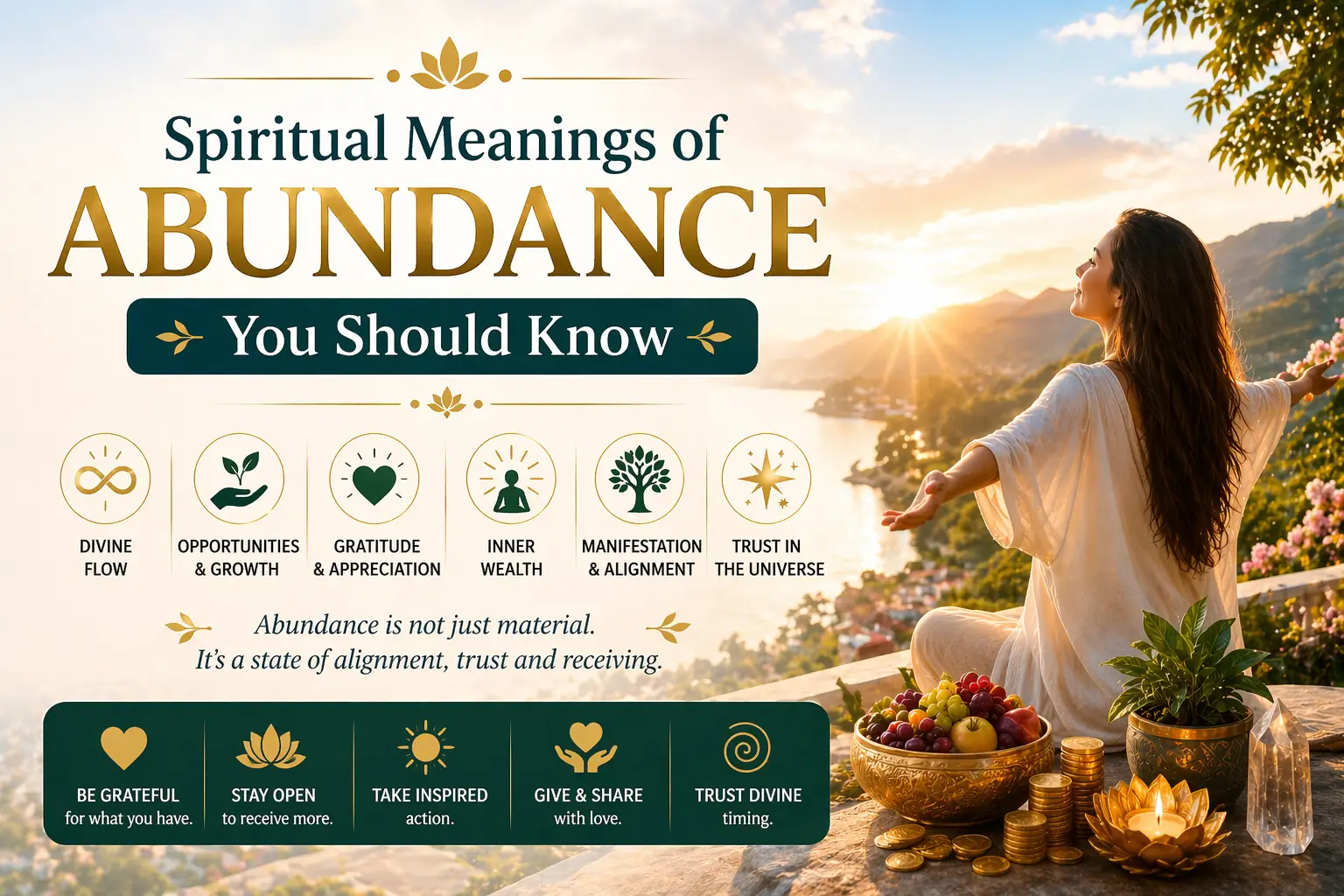
9 Spiritual Meanings of Abundance You Should Know
Spiritually, abundance means far more than money or possessions. It refers to a deep inner state of wholeness, divine alignment, and overflowing life energy that connects you to a greater universal flow. Across traditions, abundance is seen as a gift from a higher power, a reflection of inner purity, and a natural outcome of living in harmony with spiritual laws.
Many people search for abundance only in their bank accounts. But the world’s oldest spiritual traditions tell a very different story. This article explores what abundance truly means across history, religion, and spiritual practice, so you can recognize and attract it in every area of your life.
What Does Abundance Mean Spiritually? A Historical Overview
The Root of the Word
The word “abundance” comes from the Latin abundantia, meaning “fullness” or “plenty.” It combines ab (from) and undare (to rise in waves). So at its very root, abundance is not static. It is something that flows and surges outward in waves.
This matters spiritually. True abundance is not something you hoard or accumulate. It is something that moves through you and out into the world.
Abundance Across World History
Ancient civilizations connected abundance to the divine from the very beginning. In Mesopotamia, overflowing grain stores were seen as proof of divine favor. In ancient Egypt, gold and the flooding of the Nile were symbols of sacred generosity.
Every major spiritual tradition has grappled with what abundance means, what causes it, and how to invite it. Most traditions agree on one thing: abundance is ultimately a spiritual state before it is a material one.
Abundance Across Major Spiritual Traditions
| Tradition | View of Abundance | Key Concept |
|---|---|---|
| Hinduism | Divine gift tied to righteousness and inner purity | Lakshmi Tattva |
| Buddhism | Inner richness through compassion; warns against hoarding | Dana (generosity) |
| Christianity | Spiritual fullness as God’s gift; more than material wealth | Perissos (overflowing life) |
| Islam | Rizq (provision) from Allah; gratitude multiplies blessings | Shukr (thankfulness) |
| African Traditional Religion | Blessings from ancestors and community harmony | Ubuntu (collective well-being) |
| Native American | Abundance tied to nature’s cycles and gratitude to the land | Sacred reciprocity |
| Taoism | Natural flow of life energy when one is in alignment | Wu Wei (effortless flow) |
| New Thought / Law of Attraction | Inner mindset creates outer reality | Vibrational frequency |
9 Spiritual Meanings of Abundance You Should Know
1. Abundance as Divine Blessing
In most religious traditions, abundance flows directly from a higher power. It is not earned through cunning or luck. It is granted as a sacred gift to those who align with spiritual principles.
In Islam, the concept of Rizq describes all provision as coming directly from Allah. Nothing a person receives is outside of divine will. Gratitude, or Shukr, is believed to multiply this provision according to Quranic teaching.
In Christianity, John 10:10 records Jesus saying he came so that people might have life “more abundantly.” The Greek word used, perissos, means something that far exceeds the ordinary. It points to quality and depth, not just quantity.
2. Abundance as Inner Consciousness
Many spiritual teachers say abundance is not about what you have. It is about how you see. This is one of the most transformative definitions of abundance across traditions.
Spiritual teachers from Eckhart Tolle to ancient Hindu sages have emphasized that a sense of inner fullness comes first. When you feel internally complete, you stop operating from a place of lack. That shift in perception changes what you attract and what you notice.
From a spiritual standpoint, abundance is an inner state of consciousness that is independent of external circumstances. It is accessed through mindfulness, gratitude, and inner alignment, not through acquiring more things.
3. Abundance in Hinduism: The Lakshmi Principle
In Hinduism, Goddess Lakshmi is the divine embodiment of abundance, wealth, beauty, and prosperity. She has been worshipped since pre-Buddhist times, dating back to 1500 BCE. Her image shows her seated on a lotus, with golden coins flowing endlessly from her palm.
The teaching is profound. The coins flow, but her expression is serene and non-attached. True abundance, Hinduism says, flows through you when you are generous and detached, not when you are grasping and fearful.
Hindu philosophy describes Lakshmi Tattva as a sacred balance of material abundance, inner purity, ethical living, gratitude, and service. Where dharma (righteousness) exists, Lakshmi naturally resides. Where greed and arrogance dominate, she quietly withdraws.
4. Abundance in Buddhism: The Wealth of Compassion
Buddhism offers a nuanced view of abundance. It does not reject material prosperity outright. But it places far greater value on inner richness, especially the boundless compassion represented by figures like Avalokiteshvara.
The Buddhist concept of Dana, or generosity, is seen as the foundation of abundance. When you give freely without expectation, you align yourself with the natural flow of universal energy. Holding tightly to resources blocks that flow.
Buddhism also warns against monks accumulating excessive material goods, which is seen as a contradiction to their path. For lay practitioners, material prosperity is acceptable when it is pursued ethically and shared generously with others.
5. Abundance in African Traditional Religion
In African spirituality, abundance is deeply communal. The Yoruba, Igbo, Zulu, and other traditions understand prosperity not as an individual achievement but as a collective blessing that flows through right relationships with ancestors, community, and the divine.
Cowrie shells were used as currency across many African cultures and also carried deep spiritual meaning. They represented wealth, fertility, and divine favor. Their smooth, flowing shape symbolized the endless flow of blessings from the spirit world.
The Adinkra symbols of the Akan people of Ghana also speak to abundance. The concept of Ubuntu, found across many African traditions, teaches that a person thrives through others. Abundance, in this view, is inseparable from community well-being.
6. Abundance in Native American Traditions
Native American cultures connected abundance directly to the earth and its cycles. The sun, salmon, corn, and rain were not just food sources. They were sacred givers of life, and gratitude toward them was considered spiritually essential.
The corn symbol, for example, signifies life, sustenance, and spiritual blessings in many tribes. Salmon represented abundance, especially for the Inuit and Pacific Northwest tribes, because it sustained entire communities through harsh seasons.
The relationship with nature was one of sacred reciprocity. You give gratitude and respect to the land. The land gives back abundance. This two-way spiritual exchange is at the heart of indigenous understandings of prosperity.
7. Abundance and Gratitude: The Universal Key
Across virtually every tradition, gratitude is the single most common gateway to abundance. It appears in Hinduism as Santosha (contentment), in Buddhism as appreciation for goodness, in Christianity as giving thanks in all circumstances, and in Islam as Shukr.
Gratitude shifts your focus from what is missing to what is present. This is not just spiritual philosophy. Research in positive psychology, including work by Dr. Martin Seligman, supports the idea that a gratitude practice measurably increases well-being and a sense of sufficiency.
When you feel grateful, you feel full rather than empty. That felt sense of fullness is the spiritual state of abundance, and it naturally attracts more experiences and resources that match it.
8. Abundance and the Law of Attraction
The Law of Attraction holds that your dominant thoughts and emotional vibration attract matching experiences. It is a modern spiritual framework, but it echoes ancient teachings from Hinduism, Taoism, and Hermeticism.
The core idea is simple. When you embody abundance in your thoughts, emotions, and actions, you attract more abundance from the world around you. When you operate from fear and lack, you attract more experiences that confirm that scarcity.
Lakshmi’s teaching carries exactly this message. The classic spiritual paradox is this: chase wealth and it withdraws. Embody wealth through gratitude and generosity, and it pours in.
9. Abundance as Spiritual Alignment
Many traditions teach that abundance is the natural result of being in right relationship with the universe, God, or the divine. It is not forced or manipulated. It flows naturally when you are aligned.
In Taoism, this is called Wu Wei, or effortless action. When you stop struggling against the current of life and instead flow with it, things come to you more easily. Abundance becomes effortless when inner alignment is achieved.
This aligns with the Upanishadic teaching from Hinduism that Lakshmi “dwells where there is contentment, wisdom, and alignment with one’s higher self.” Alignment is the prerequisite. Abundance is the natural outcome.
Spiritual Symbols of Abundance Across Cultures
| Symbol | Culture/Tradition | Meaning |
|---|---|---|
| Lotus Flower | Hinduism, Buddhism | Spiritual purity, wealth rising from mud |
| Cornucopia | Greek/Western | Endless flow of nourishment and gifts |
| Cowrie Shell | African traditions | Wealth, divine favor, feminine energy |
| Hamsa Hand | Islam, Judaism, Middle East | Divine blessing and protection against lack |
| Salmon | Native American (Pacific Northwest) | Abundance, renewal, spiritual sustenance |
| Sun Symbol | Native American (multiple tribes) | Life-giving abundance, crop fertility |
| Laughing Buddha (Budai) | Chinese Buddhism | Welcoming prosperity and joy |
| Adinkra symbols | Akan (West Africa) | Community wealth and spiritual growth |
| Lucky Bamboo | Chinese / Feng Shui | Steady flow of positive energy and wealth |
| Gold Coins | Hinduism (Lakshmi iconography) | Material and spiritual prosperity |
Abundance in Different Conditions: What Changes and What Stays the Same
| Condition | Spiritual Meaning | What To Do |
|---|---|---|
| Financial lack | Invitation to examine inner beliefs about worth | Practice gratitude and align actions with values |
| Sudden windfall | Test of ethical stewardship and generosity | Share and give back as part of spiritual practice |
| Feeling emotionally empty | Sign of inner scarcity mindset | Work on inner healing and mindfulness practices |
| Career stagnation | Possible misalignment with purpose | Seek clarity on your dharma or life mission |
| Relationship abundance | Sign of living generously and openly | Nurture connections as a form of spiritual wealth |
| Creative overflow | Spiritual alignment with your gifts | Honor and express your gifts as sacred service |
| Physical health and vitality | Lakshmi also governs bodily abundance | Care for your body as a sacred vessel |
What To Do: Practical Steps to Invite Spiritual Abundance
Start with gratitude. Each morning, write down three things you are genuinely thankful for. This simple act rewires your focus from what is missing to what is already overflowing in your life.
Practice generosity intentionally. In nearly every tradition, giving is the fastest path to abundance. Give time, resources, or attention to someone in need. Generosity signals to the universe that you already have more than enough.
Work on inner alignment. Ask yourself honestly: do my daily actions match what I say I value? When your life is in harmony with your spiritual beliefs, abundance tends to flow with much less effort.
Clear limiting beliefs about money and worth. Many people carry unconscious beliefs that money is evil, or that they are not worthy of good things. Journaling, prayer, meditation, and energy work can help reveal and release these blocks.
Connect to a tradition or practice. Whether it is Lakshmi puja, Christian prayer, Islamic dhikr, or mindful meditation, connecting to a spiritual practice grounds you in something larger than yourself. That connection opens the channel for abundance.
Honor your body and your home. Feng Shui, Vastu Shastra, and many indigenous traditions teach that your physical environment reflects your inner state. Clean, ordered, and intentional spaces invite a cleaner flow of abundant energy.
Key Takeaways
Spiritual abundance is not the same as material wealth. It is a state of inner fullness, divine alignment, and right relationship with the world around you.
Every major tradition, from Hinduism and Buddhism to African traditional religion and Native American spirituality, sees abundance as the natural outcome of gratitude, generosity, and ethical living.
Gratitude is the universal key. It appears in every tradition as the most direct path to shifting from a mindset of scarcity to one of abundance.
The Law of Attraction echoes ancient wisdom. Your inner state creates your outer experience. Align your thoughts, emotions, and actions with abundance, and abundance responds.
Abundance is communal, not just personal. African traditions especially remind us that true prosperity uplifts the community. What flows to you should flow through you.
Frequently Asked Questions
What is the spiritual meaning of abundance?
Spiritually, abundance means living in a state of inner fullness and divine alignment. It goes far beyond material wealth. It includes love, health, purpose, creativity, and peace. Most traditions describe it as the natural result of gratitude, generosity, and spiritual alignment.
What does the Bible say about spiritual abundance?
The Bible describes spiritual abundance in John 10:10, where Jesus says he came so people could have life “more abundantly.” The Greek word perissos means something far exceeding the ordinary. Biblical abundance refers to fullness of life, grace, and divine favor rather than simply material riches.
What is the Law of Attraction and abundance?
The Law of Attraction teaches that your dominant mental and emotional vibration attracts matching experiences. When you genuinely feel abundant through gratitude and generosity, you align with experiences that confirm and expand that abundance. This concept is echoed in Hindu, Taoist, and ancient hermetic teachings.
How does Hinduism view abundance?
Hinduism sees abundance as a sacred gift governed by Goddess Lakshmi. True prosperity in Hindu philosophy is called Lakshmi Tattva, which balances material wealth with inner purity, ethical living, and service. Lakshmi is said to reside where there is dharma, gratitude, and contentment.
What is the difference between spiritual abundance and material wealth?
Material wealth refers to money, property, and possessions. Spiritual abundance is an inner state of wholeness and sufficiency that exists independent of external circumstances. A person can be materially wealthy but spiritually impoverished, and vice versa. Most traditions say spiritual abundance often leads to material sufficiency over time.
What role does gratitude play in spiritual abundance?
Gratitude is the most universally recognized pathway to abundance across all spiritual traditions. In Hinduism it is Santosha, in Islam it is Shukr, in Buddhism it is appreciation for goodness, and in Christianity it is giving thanks in all things. Gratitude shifts focus from lack to fullness and opens the channel for more blessings.
What are signs of spiritual abundance?
Signs of spiritual abundance include a deep sense of inner peace, meaningful relationships, clarity of purpose, creative energy, physical vitality, and a feeling that you have enough and to spare. You may also notice synchronicities, unexpected opportunities, and a general sense that life is supporting you.
How is abundance viewed in African traditional religion?
In African traditional spirituality, abundance is communal and ancestral. Blessings flow from maintaining right relationships with ancestors, the community, and the spirit world. Cowrie shells, traditionally used as currency, represent divine favor. The concept of Ubuntu, meaning “I am because we are,” places collective well-being at the center of true prosperity.
Sources and further reading: