
Moles on the Face Meaning for Females and Males
Moles on the face carry spiritual meanings tied to destiny, personality, and luck and these meanings shift based on location, side, color, and gender. Ancient systems like Indian Samudrika Shastra, Chinese Mian Xiang, and Western astrology each offer a layered map of the face. A forehead mole may reflect wisdom or leadership. One near the lips signals charm and communication power. Knowing your mole’s placement helps you understand the energy it reflects.
What Are Moles, Scientifically Speaking?
Moles form when melanocytes the skin’s pigment-producing cells cluster together instead of spreading out evenly. According to the National Cancer Institute, most people develop between 10 and 40 moles by adulthood.
They can be flat or raised, dark brown, black, pink, or flesh-toned. Genetics, sun exposure, and skin tone all influence how many moles a person develops.
Medical note: Any mole that changes in color, size, or shape or bleeds or itches should be evaluated by a dermatologist. This article covers cultural and spiritual interpretations only.
The Cultural History Behind Facial Moles
Humans have read meaning into facial moles for thousands of years. Three major traditions dominate this practice today.

Samudrika Shastra is the ancient Indian system. According to Wikipedia, the Sanskrit term translates roughly as “knowledge of body features.” It is rooted in Hindu metaphysics and links physical marks to karma and one’s life purpose (dharma). Major Hindu texts including the Garuda Purana and the Mahabharata reference it.
Mian Xiang is the Chinese art of face reading. Wikipedia describes Mien Shiang as a physiognomic and fortune-telling practice based on the five phases (wu xing). The Chinese developed a 100-year face map where each position represents one year in a person’s life. For males, counting begins from the left side. For females, it begins from the right side.
Western astrology links moles to planetary energies. Each planet governs a body part, and a mole there amplifies that planet’s traits. This tradition also ties moles to one’s soul expression and unique life path.
Why Location Matters More Than Anything Else?

All three traditions agree on one core principle: placement is everything. Even a few millimeters to the left or right can shift a mole’s meaning entirely.

The side of the face matters too. The right side is generally linked to positive, outward, and masculine energy. The left side connects to inner life, emotions, and feminine energy.
Color and size add another layer. A dark, clear, well-shaped mole is considered more auspicious and influential. A faint or irregular mole may point toward challenges or slower-developing traits.
Mole Color and What It Means

| Mole Color | General Meaning Across Traditions |
|---|---|
| Dark black / deep brown | Bold energy, bravery, strong character |
| Light brown | Gentle, calm, kind personality |
| Red | Creativity, compassion, passion |
| Flesh-toned / skin color | Subtle influence, hidden potential |
| Raised mole | Active energy, strong impact |
| Flat mole | Steady, calm character traits |
Moles on the Forehead
A forehead mole is one of the most significant placements across all traditions. In Chinese face reading, the forehead is the “Heaven’s Palace” a zone connected to divine energy and ancestral blessings.
In Hinduism, a forehead mole links to the third eye chakra and the Sun. It reflects accumulated good karma from past lives. If it appears on the right side, it connects symbolically to Lakshmi, the Hindu goddess of wealth and fortune.
For females: A forehead mole signals strong intuition and emotional intelligence. Women with this mark often face early challenges but achieve peace and success in later years.
For males: The forehead mole reflects leadership, ambition, and mental strength. Men with this mark earn trust through confidence and clear decision-making.
Right side of forehead: Linked to luck, ambition, and early recognition. Both genders with this placement are seen as practical thinkers who attract career opportunities.
Left side of forehead: Suggests artistic talent and deep thinking. For males, it may indicate being a spendthrift. For females, it can signal career obstacles alongside a reflective and profound mind.
Near the hairline: Points to hidden intelligence and a mysterious personality. These individuals stay calm under pressure and often spot opportunities others miss.
Moles on the Cheek
The cheek sits close to both the eyes and mouth, making it a zone of expression and emotion in face reading. Across cultures, a cheek mole marks charm, willpower, and social destiny.
In Samudrika Shastra, a cheek mole is associated with wealth, beauty, and social respect. In Chinese face reading, it signals strong willpower and emotional honesty.
Right cheek for females: Reflects grace, magnetism, and emotional depth. Women with this mole are often charming, socially connected, and prosperous.
Right cheek for males: Signals leadership, authority, and strong willpower. Men with this mole attract respect through natural confidence and rise to positions of social recognition.
Left cheek: Across traditions, this is linked to emotional sensitivity and inner life. It suggests richer personal struggles but also deep empathy.
Moles on the Nose
The nose occupies the central position on the face, making it one of the most noticed mole locations. In Vedic astrology, the nose is ruled by Mars the planet of action, courage, and energy.
A nose mole amplifies Martian qualities: bold confidence alongside a tendency toward impulsiveness.
For females: A nose mole reflects confidence, sensual charm, and independence. These women are known for strong opinions and magnetic personalities.
For males: This mole signals drive, charisma, and worldly ambition. The challenge linked to this placement is learning to channel energy without becoming hot-tempered.
Tip of the nose: Linked to quick financial gains and natural social popularity.
Side of the nose: May indicate fluctuating prosperity or challenges in managing material abundance.
Bridge of the nose: Points toward travel, frequent change of environment, and a restless but adventurous spirit.
Moles on the Lips
Moles near or on the lips are considered some of the most charming placements. In Chinese face reading, the mouth zone connects to prosperity, relationships, and the enjoyment of life’s pleasures.
Western astrology links lip moles to strong communication skills and the ability to attract attention through speech or personality.
For females: A mole near the lips signals sensuality, charm, and the ability to communicate with deep impact. These women excel in persuasion, creativity, and emotional expression.
For males: This placement suggests a talented communicator with a natural gift for building relationships. It can indicate success in media, public speaking, law, or the arts.
Upper lip mole: Connected to food, indulgence, and enjoyment. It may also suggest a deep attachment to family and loved ones.
Lower lip mole: Often associated with a creative mind and a love of storytelling or artistic pursuits.
Moles on the Chin
The chin in face reading represents determination, willpower, and stability. A mole here is generally considered one of the most positive placements across traditions.
In Samudrika Shastra, a chin mole represents self-made success. In Chinese face reading, it symbolizes authority and a peaceful home life. In some Middle Eastern traditions, it is interpreted as a sign of divine favor and personal charisma.
For females: A chin mole signals wisdom, independence, and a strong will. Women with this mark often build long-lasting, meaningful relationships and serve as the emotional backbone of their families.
For males: This placement links to ambition, leadership, and the drive to shape one’s own destiny. These men rarely stay defeated by setbacks.
Moles on the Eyebrows
The eyebrow zone in Vedic astrology connects to fortune, relationships, and career progress. The exact position within the brow changes the interpretation significantly.
Right eyebrow for males: Traditionally associated with wealth, early marriage, and property gained through partnerships. It also connects to successful business and social status.
Left eyebrow for males: Associated with impatience, impulsive behavior, and self-indulgence. It signals the need for discipline.
For females: A mole between the eyebrows is considered highly auspicious. It is said to indicate marriage to a person of high social standing and a stable, respected life.
Middle of the eyebrow (either gender): Points to luck, wealth, and a steady rise through life. This is one of the luckiest placements in Vedic mole astrology.
Moles on the Eyes and Eyelids
The eye zone is deeply symbolic. Eyes represent vision, intuition, and emotional life across virtually every culture.
In Chinese astrology, the left eye is linked to wisdom and deep thinking, while the right eye reflects charm and social grace. In African traditional beliefs, moles around the eyes represent divine protection. Western traditions connect eye-area moles to the third eye a symbol of heightened awareness.
For females: A mole on or near the eyelid is considered highly auspicious in Indian astrology. It is linked to wealth, success, and recognition material, social, and spiritual.
For males: A mole on the right eyelid signals that the person must remain humble despite success. It points toward hidden inner potential and a need for spiritual grounding.
Under the eye: Suggests strong empathy and emotional depth. It may also indicate challenges in relationships caused by feeling things too deeply.
Moles on the Temple
The temple zone in Chinese face reading connects to travel, relocation, and foreign luck. A mole here is generally considered an auspicious marker for those who thrive outside their place of birth.
For females: A temple mole brings social recognition and connections with influential people. It suggests support arriving from unexpected directions in both personal and professional life.
For males: This placement may indicate fame or success gained in foreign countries or through international exposure.
Moles by Location
| Location | Female Meaning | Male Meaning |
|---|---|---|
| Center forehead | Emotional intelligence, wisdom | Leadership, ambition, authority |
| Right forehead | Ambition, drive | Family respect, recognition |
| Left forehead | Deep thinker, possible obstacles | Artistic talent |
| Right cheek | Grace, charm, wealth | Leadership, social power |
| Left cheek | Emotional sensitivity | Inner strength, empathy |
| Nose tip | Independence, charm | Drive, charisma |
| Upper lip | Sensuality, expressiveness | Communication, relationships |
| Chin | Wisdom, independence | Ambition, resilience |
| Right eyebrow | Auspicious marriage | Wealth, property |
| Temple | Social connections, influence | Fame abroad, travel luck |
| Eyelid | Wealth, success, recognition | Inner potential, humility |
| Under the eye | Empathy, emotional depth | Sensitivity, strong feelings |
Moles on the Face in Islamic Tradition
Islam as a religion does not endorse astrology or fortune-telling. There are no Islamic religious teachings on the spiritual meaning of facial moles.
However, in classical Arabic cultural and poetic tradition, the “khaal” (خال) the beauty mark near the lips or cheek was celebrated as a symbol of beauty and charm. Classical Arabic poetry frequently referenced it as a mark of perfection.
This is a cultural and aesthetic tradition, not a religious one. The distinction matters.
Moles in Medieval European History
Medieval European tradition offers a darker chapter in mole interpretation. During the Middle Ages, a prominent mole or unusual skin mark was sometimes associated with witchcraft or demonic influence.
Women accused of witchcraft were often examined for unusual skin marks. This led to the iconic imagery of the “witch’s mole” on the nose a harmful stereotype with real historical consequences.
By the 17th and 18th centuries, this interpretation flipped entirely. Noblewomen in France and England would paint artificial “mouches” (fake moles) on their cheeks as signs of elegance and allure. The mole near the lips became a celebrated “beauty spot” a symbol of high social status and charm.
Moles in African Traditional Beliefs
African traditional belief systems treat moles and physical marks as signs of spiritual lineage and ancestral connection. In many West African traditions, a mole near the eye or forehead is interpreted as a sign that the person carries protective ancestral energy.
Some traditions link moles to the spirit world not as omens but as markers of spiritual sensitivity. A person with prominent facial moles may be considered closer to the ancestors or gifted with heightened intuitive abilities.
Moles in Hoodoo and Folk Magic Traditions
In Hoodoo a spiritual folk tradition rooted in African American culture body marks including moles are sometimes read as signs of a person’s natural spiritual gifts. A mole near the eye may suggest clairvoyance or the ability to “see” beyond the ordinary.
Hoodoo does not follow the same structured face-map systems as Chinese or Vedic traditions. It tends to approach moles intuitively, often within the context of a reading performed by a root worker or spiritual practitioner.
Moles and Personality: Cross-Cultural Connections
| Placement | Personality Traits Linked |
|---|---|
| Forehead | Intelligent, authoritative, destiny-driven |
| Cheeks | Charming, emotionally honest, socially strong |
| Nose | Independent, passionate, financially active |
| Lips | Communicative, creative, romantically expressive |
| Chin | Determined, resilient, grounded |
| Eyebrows | Fortunate, relationship-focused, driven |
| Eyes / Eyelids | Intuitive, empathetic, emotionally aware |
| Temple | Adventurous, internationally connected, social |
What To Do: A Practical Section
Step 1: Identify the exact location
Use a mirror and note where exactly the mole sits. Is it on the right or left side? Near the center, edge, or hairline? Precise placement matters in every tradition.
Step 2: Note the physical characteristics
Observe whether the mole is dark or light, raised or flat, large or small. These features modify the interpretation of the placement across all traditions.
Step 3: Research your relevant tradition
If your background is South Asian, Samudrika Shastra may resonate most. If you follow Chinese philosophy, explore Mian Xiang. If you follow Western astrology, look at which zodiac sign rules your mole’s body zone.
Step 4: Take it as inspiration, not prophecy
Every tradition emphasizes that a mole reflects tendencies and potential not fixed outcomes. How you choose to use the qualities it symbolizes is always up to you.
Step 5: Get a skin check if the mole is changing
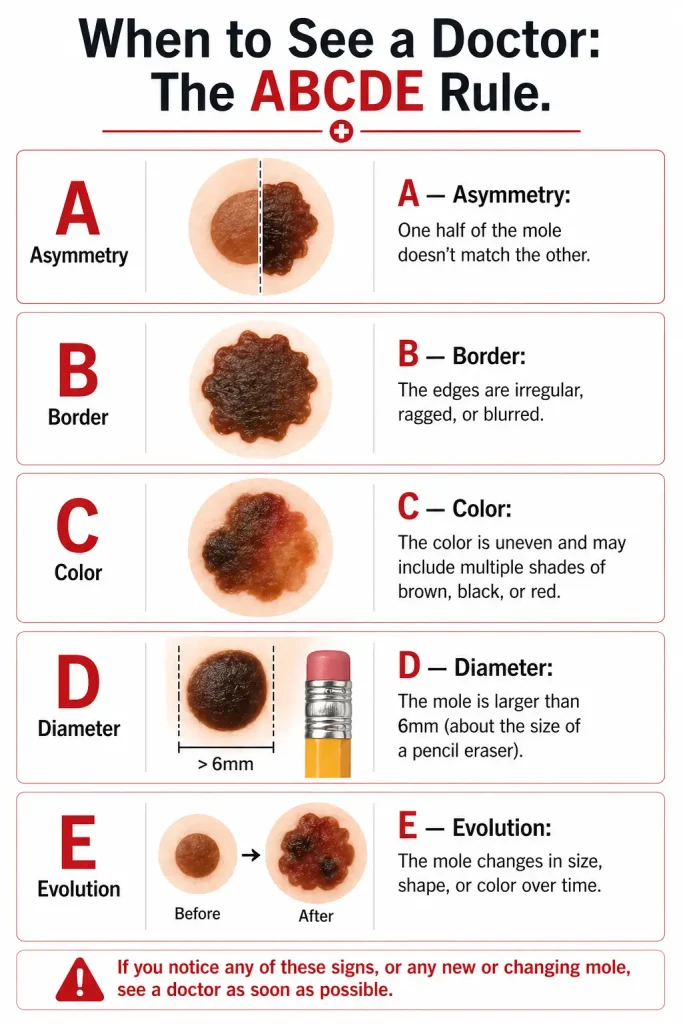
Cultural meaning is one thing. Medical health is another. If your mole has recently changed in color, size, or shape or if it itches or bleeds see a dermatologist without delay.
Key Takeaways
- Facial moles have been interpreted across Indian (Samudrika Shastra), Chinese (Mian Xiang), and Western astrological traditions for thousands of years.
- Location is the most important factor. The right side of the face generally carries more positive, outward-facing meaning. The left side links to inner emotional life.
- Female and male interpretations often differ. For females, meanings connect to intuition, charm, and emotional intelligence. For males, they connect more often to ambition, leadership, and career.
- Mole color adds meaning. Dark moles are considered stronger and more auspicious. Light or faint moles suggest gentler, quieter traits.
- These are cultural and spiritual interpretations rooted in ancient wisdom not scientific facts. They should not replace medical evaluation.
- Any physically changing mole should be checked by a qualified dermatologist. Melanoma, the most serious skin cancer, can develop from moles.
Frequently Asked Questions
What does a mole on the face mean spiritually?
Across traditions, a facial mole is considered a mark of destiny and personal energy. It is believed to reflect past-life karma, personality tendencies, and the direction of one’s life path. The specific meaning depends on exact location, color, and gender. Most traditions agree that moles are not curses or blessings by themselves they are mirrors of one’s inner nature and potential.
Is a mole on the face lucky or unlucky?
Most placements are considered auspicious or neutral. Certain spots like the center forehead, right cheek, chin, and between the eyebrows are widely regarded as lucky across multiple traditions. Some locations may indicate challenges, but those are generally seen as lessons to grow through rather than permanent misfortune.
Do moles on the face mean the same thing for females and males?
No. Gender plays a significant role in traditional interpretation. A mole on the nose signals independence and charm for females but boldness and occasional hot-temperedness for males. The right cheek signals grace and social wealth for women and leadership for men.
What is the meaning of a mole on the right side of the face?
The right side is generally associated with positive energy, outward success, and social recognition in both Chinese face reading and Vedic astrology. Moles on the right side tend to carry more favorable interpretations related to wealth, relationships, and career advancement.
What is the meaning of a mole on the left side of the face?
The left side is linked to inner emotional life, intuition, and sensitivity. Moles here are not necessarily unlucky, but they tend to relate more to personal, emotional, and spiritual matters rather than outward success. They often indicate a deeply reflective or empathetic personality.
What does a mole near the lips mean for a female?
For females, a mole near the lips is associated with charm, expressiveness, sensuality, and the ability to build strong emotional bonds. It is also linked to success in creative or communicative fields. In Chinese face reading, the mouth zone connects to prosperity through communication and relationships.
What does a mole between the eyebrows mean?
In Vedic astrology, a mole between the eyebrows for either gender is considered highly auspicious. It is linked to luck, wealth, and a steady rise through life. For women specifically, traditional interpretations suggest marriage to a high-status or respected partner.
Is a mole on the nose good or bad?
For most people, a nose mole is a powerful and active placement. It is linked to Mars energy courage, passion, and drive. Those who channel this energy constructively often attract social charisma and financial activity. The main challenge associated with it is impulsiveness, which can be managed with self-discipline.
What does a dark mole on the face mean?
A dark, well-defined mole is generally interpreted as a sign of strong life energy and clear influence in that facial zone. Dark moles are considered more impactful than light or faint ones. Their meanings follow the same placement rules, but the qualities they represent express more intensely.
What does a mole on the forehead mean in Chinese face reading?
In Mian Xiang, the forehead represents the “Heaven’s Palace” a zone connected to ancestral blessings, divine energy, and early life fortune. A clear, well-shaped mole here indicates a prosperous and fortunate life. Marks or blemishes in this zone are taken as signs of potential life disruption, while a positive mole signals a strong foundation.
Can the meaning of a mole change over time?
Traditional face reading holds that the placement and meaning of a mole remain consistent, but how a person expresses those qualities may evolve with personal growth. Some traditions note that moles may fade or shift in appearance over decades which is also viewed as meaningful. Scientifically, moles can lighten and fade naturally with age.
What did moles mean in medieval European history?
In medieval Europe, moles and skin marks were sometimes associated with witchcraft during witch trials a harmful and discredited belief. By the 17th and 18th centuries, European aristocratic culture had reversed this entirely. Facial moles became fashionable beauty spots, worn by noblewomen in France and England as symbols of elegance and status.
Do moles on the face have any meaning in Islam?
Islam does not endorse astrology or fortune-telling, so there are no Islamic religious teachings about the spiritual meaning of facial moles. In classical Arabic cultural tradition, the “khaal” the beauty mark near the lips or cheek was celebrated in poetry as a symbol of beauty and perfection. This is an aesthetic and cultural tradition, not a religious teaching.
What is the meaning of a mole in Hoodoo tradition?
In Hoodoo, a mole near the eye may suggest natural clairvoyance or spiritual sensitivity. Unlike Vedic or Chinese systems, Hoodoo does not use a structured face map. Mole meanings are interpreted intuitively, often within a broader spiritual reading. This tradition is rooted in African American folk spirituality and does not follow the same organized system as other traditions.
What should I do if I don’t like the meaning of my mole?
Every tradition that reads mole meanings also emphasizes personal agency. The meaning of a mole reflects natural tendencies and energies not a sealed fate. If your mole’s traditional meaning involves challenges, most traditions treat those as areas for growth and self-awareness. Your choices, mindset, and actions always carry more weight than any physical mark.
When should I see a doctor about a mole on my face?
See a dermatologist if a mole changes in color, size, or shape or becomes raised, itchy, bleeds, or oozes. The National Cancer Institute recommends following the ABCDE rule: Asymmetry, irregular Border, uneven Color, large Diameter (larger than a pencil eraser), and Evolution (any change). Early detection of melanoma significantly improves treatment outcomes.
Sources and Further Reading
- Samudrika Shastra Wikipedia Overview of the ancient Indian tradition of body mark reading.
- Mien Shiang Wikipedia Overview of Chinese face reading tradition.
- Moles Fact Sheet National Cancer Institute Medical information on moles, melanoma risk, and ABCDE warning signs.
- Common Moles and Risk MedlinePlus Genetics Genetic factors behind mole development.
- Moles Cleveland Clinic Comprehensive medical overview of mole types and when to seek care.
This article is for informational and cultural purposes only. It does not constitute medical, spiritual, or astrological advice. Always consult a qualified dermatologist for any concerns about skin health.