Color Green: Spiritual Meaning, Symbolism & Psychology

The spiritual meaning of color green centers on growth, healing, renewal, and divine abundance. Across the world’s major traditions, from Islam and Christianity to Hinduism and indigenous African beliefs, green stands as the color of life itself. It signals that something is thriving, beginning, or healing. If green keeps appearing in your life or dreams, it is often an invitation to open your heart, embrace change, and trust the process unfolding around you.
What Does Green Mean Spiritually?
Green is nature’s most dominant color, covering roughly 70% of Earth’s land surfaces in the form of forests, grasslands, and plants. This sheer presence in the natural world is exactly why it carries such deep spiritual weight. When ancient peoples saw green after a long winter, they understood it as a divine sign that life had returned.
Spiritually, green bridges the physical and the spiritual. It is the color that sits at the center of the visible light spectrum, balancing the warmer tones of red and yellow with the cooler tones of blue and violet. This middle position is not accidental in spiritual thought it mirrors green’s role as a bridge between earth and heaven, body and soul.
Green holds a dual nature that most articles miss. It can mean healing and hope, but it also carries the shadow of envy, decay, and illusion. Understanding both sides gives a more complete and honest picture of this color’s spiritual energy.
Green Across Major World Religions

Islam: The Color of Paradise
In Islamic tradition, green holds a uniquely sacred status unlike any other color in the faith. The Quran references green multiple times as the color of the garments and cushions worn by the inhabitants of Paradise (Jannah). This makes green a color of divine reward, eternal life, and God’s ultimate promise to the faithful.
The Prophet Muhammad is widely reported to have favored green, and this reverence has shaped Islamic art and architecture for over 1,400 years. The domes of mosques, the covers of Qurans, and the flags of several Muslim-majority nations prominently feature green. It signals spiritual protection, divine mercy, and the lush beauty that awaits those who live righteously.
Christianity: Hope and Ordinary Time
In Christian liturgy, green is the color assigned to Ordinary Time, which covers nearly 33 weeks of the church calendar each year. During this long season, green vestments and altar cloths signal a period of spiritual growth, steady faith, and deepening relationship with God.
The Bible uses green imagery with striking spiritual depth. Psalm 23:2 describes God leading the soul to “green pastures,” a metaphor for divine rest and nourishment. Jeremiah 17:8 compares the faithful person to a tree whose “leaves are always green,” meaning one who is spiritually alive regardless of external pressures.
The Hebrew word raanan (רַעֲנָן), meaning lush or flourishing, appears over 20 times in the Old Testament. It consistently describes people and lands that are aligned with God’s will. In the New Testament, the Greek word chloros appears in Mark 6:39 and also, strikingly, in Revelation 6:8, where it describes a sickly pale horse of death showing that green, severed from its source, can also symbolize spiritual rot.
Hinduism: Vishnu, Anahata, and the Balance of Creation
In Hindu tradition, green is sacred primarily through two lenses: the deity Vishnu and the heart chakra. Lord Vishnu, the preserver of the universe, is often depicted with a dark green or blue-green complexion. This color reflects his connection to nature, fertility, and the sustaining force of the cosmos. Green offerings of leaves and plants are used in temple rituals to invoke auspiciousness and divine blessing.
The heart chakra, Anahata (Sanskrit: अनाहत), is represented by a vibrant green lotus with twelve petals. According to Wikipedia’s entry on Anahata, the name translates to “unstruck sound,” pointing to a love that exists without effort or condition. The twelve petals each represent a spiritual quality including compassion, harmony, love, and forgiveness. At Anahata’s center is a hexagram formed by two interlocking triangles, representing the union of Shiva (masculine) and Shakti (feminine) energies.
Significantly, Anahata is the chakra from which 72,000 nadis (energy channels) are said to originate, making it the central hub of the entire human energy system. This is why spiritual development cannot bypass the heart, and why green holds such transformational power in yogic practice.
Ancient Egypt: Osiris and the Green Skin of Eternity
In ancient Egyptian religion, green was directly associated with resurrection and eternal life. Osiris, the god of the afterlife, was frequently depicted with green skin. This was not a metaphor Egyptians believed his green color literally represented the regenerative force of the earth and the promise that life continues after death.
Egyptian priests used green malachite as eye paint in rituals, linking their gaze to divine sight and the power of renewal. The hieroglyph for green (wadj) also meant “to flourish” and “to be healthy,” embedding spiritual meaning directly into the language itself.
Celtic and Druidic Traditions: The Earth Goddess and Forest Spirits
In Celtic and Druidic spirituality, green was the sacred color of the earth goddess and the invisible spirits dwelling in forests, rivers, and hills. Ancient Celts wore green during planting and harvest rituals to honor these nature spirits and invite their blessing upon crops and families.
The Green Man, a face wreathed in leaves found carved in hundreds of medieval European churches, is a pre-Christian symbol of nature’s cyclical death and rebirth that survived into Christian sacred spaces. His face emerging from foliage represents the idea that spiritual life is inseparable from the natural world.
Buddhism: Emerald Buddha and Green Tara
In Tibetan Buddhism, the color green is associated with Green Tara, a bodhisattva of enlightened activity, compassion, and swift protection. She is depicted in vivid green to represent her unceasing action in the world, her readiness to respond to suffering without delay.
The Emerald Buddha in Bangkok’s Wat Phra Kaew is one of the most sacred icons in Southeast Asian Buddhism. Though scholars believe the statue is carved from green jasper rather than emerald, its green color carries associations of life, protection, and Buddha’s presence in the world.
Judaism: Spring, Passover, and Covenant Land
In Jewish tradition, green appears on the Passover Seder plate in the form of karpas, a green vegetable (often parsley or celery). This green sprig symbolizes springtime, the renewal of the earth, and the hope that emerged from Egyptian slavery. It is dipped in salt water, linking new life with the tears of suffering a reminder that growth often follows hardship.
The Hebrew concept of the Promised Land flowing with “milk and honey” is fundamentally a green land, one whose visible lushness signals divine covenant and blessing.
Hoodoo: Green for Money, Luck, and Good Crops
Hoodoo is a spiritual tradition developed by African Americans in the Southern United States, drawing from West and Central African practices, Indigenous herbalism, and elements of Christianity. In Hoodoo candle magic, each color carries a specific spiritual function.
Green is the primary color for prosperity work in Hoodoo. Green candles are burned for financial gain, business success, gambling luck, and good crops. Green-painted lodestones are dressed with magnetic sand to draw wealth and opportunity toward the practitioner.
According to the tradition documented by Zora Neale Hurston in Mules and Men (1935) and later codified by Henri Gamache in The Master Book of Candle-Burning (1942), green candles are used specifically for money spells, favorable employment, and agricultural abundance. This grounding of green in material provision reflects the tradition’s African roots, where the earth’s green abundance was understood as directly tied to spiritual favor and ancestral blessing.
Wicca: Green for Fertility, Harmony, and Earth Magic
In Wicca and broader modern Pagan practice, green is associated with the element of Earth and the fertility of the natural world. Green candles and ritual tools are used in spells and ceremonies focused on prosperity, fertility, romantic attraction, friendship, and healing.
Green is the color of the Goddess in her aspect as the nurturing earth, and it is prominently featured in Beltane (May Day) celebrations, which honor the peak of spring fertility. Wiccans working with green energy often incorporate herbs, living plants, and time spent in nature as part of their spiritual practice.
African Traditional Beliefs: Green as Growth and Ancestral Abundance
Across diverse African cultures, green holds meanings rooted in the abundance of the land and the favor of ancestral spirits. Among the Akan people of Ghana, green appears in Kente cloth patterns where it communicates growth, renewal, and spiritual vitality. Each combination of colors in Kente tells a complete spiritual and social story, making green a key element of coded ancestral wisdom.
In many West and Central African traditions, the color of the natural world is seen as the visible expression of the spirit world’s health. When the land is green and fertile, the spirits of the ancestors are at peace and the community is in right relationship with the divine. Green absence, such as drought and bare land, signals spiritual disorder requiring ritual correction.
The Pan-African colors of red, black, and green, adopted widely across the African continent and diaspora, include green specifically to represent the land, its fertility, and the hope of future generations. This is a deeply spiritual choice, not merely a political one.
The Heart Chakra: Why Green Is the Color of Love
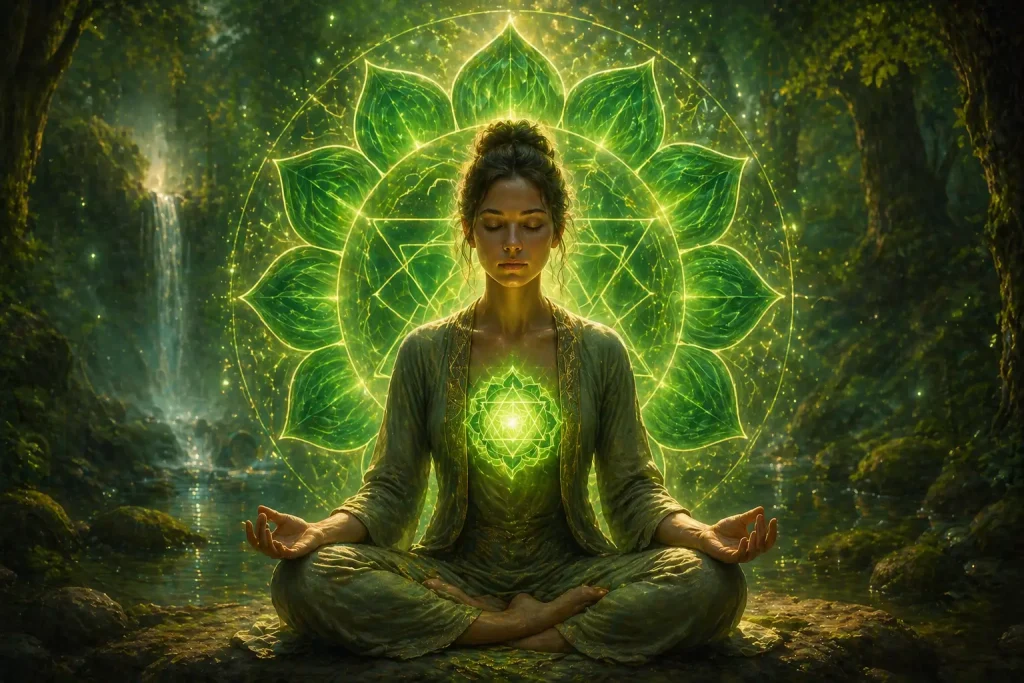
Most people assume love is red. In the chakra system, however, love is green. The heart chakra, Anahata, sits at the center of the seven-chakra system between the three lower chakras that govern physical survival and the three upper chakras that connect to higher consciousness.
This central position is spiritually significant. Green is the meeting point between earth and sky, body and spirit. When Anahata is open and balanced, a person can give and receive love freely, forgive without resentment, and feel genuine compassion for themselves and others.
When Anahata is blocked, the physical consequences can include heart tension, respiratory tightness, and a protective hunched posture. The emotional signs are emotional withdrawal, difficulty trusting, and an inability to let go of old wounds. Green, in meditation and healing work, is used to activate this center and restore the flow of compassionate energy.
The seed mantra of the heart chakra is YAM (यं). Chanting this sound during green visualization or meditation is a traditional practice for balancing Anahata and expanding one’s capacity for unconditional love.
Shades of Green and Their Distinct Spiritual Meanings

Not all green carries the same spiritual weight. The shade significantly shifts the meaning:
| Shade | Spiritual Meaning |
|---|---|
| Bright/Lime Green | New beginnings, youthful energy, fresh starts |
| Emerald Green | Abundance, wisdom, sacred power, heart healing |
| Dark/Forest Green | Stability, deep roots, ancestral connection, material success |
| Pale/Mint Green | Clarity, mental calm, emotional gentleness, peace |
| Olive Green | Peace, endurance, resilience, grounded hope |
| Teal/Blue-Green | Healing communication, emotional truth, spiritual clarity |
Dark green carries an important shadow note. It can represent ambition and material success, but it also risks tipping into greed or possessiveness when not balanced by gratitude and humility. Spiritually, dark green challenges a person to pursue goals without losing their ethical center.
Green in Dreams: What Is Your Subconscious Communicating?

Green in dreams is generally a positive signal from the subconscious or spirit realm. A green field or forest often represents inner peace, a return to your authentic self, or a period of spiritual growth unfolding beneath the surface.
A green door in a dream is a classic symbol of a new opportunity or life chapter that is available to you. It suggests the door is open the question is whether you will choose to walk through it.
Wilting or dead green plants in a dream can point to neglected spiritual growth, unaddressed emotional wounds, or energy that needs tending. The message is not one of failure but of invitation to return attention and care to what matters.
Wearing green in a dream often signals that the dreamer is entering a healing phase or being spiritually protected during a vulnerable period of transition.
Green in Alchemy and Esoteric Traditions

In Western alchemy, green holds a fascinating and often overlooked role. The Green Lion (Viridis Leo) is one of alchemy’s most important symbols, representing a corrosive primal energy capable of dissolving what is false to reveal what is true. It embodies raw natural force before it has been refined by wisdom.
Green in alchemy also relates to the concept of viriditas, a Latin term used by the medieval mystic Hildegard von Bingen to describe the greening force of divine life running through all living things. She understood this green vitality as nothing less than God’s creative energy animating the natural world.
The alchemical stage of putrefaction, paradoxically, is often depicted in shades of green. This may seem dark, but alchemically it is necessary the dissolution of the old form is what makes space for genuine transformation. Green, even in decay, carries the seed of new life.
Green and the Psychology of Healing
Research in environmental psychology consistently shows that exposure to green environments reduces cortisol (the stress hormone), lowers heart rate, and improves cognitive performance. This scientific finding aligns precisely with what spiritual traditions have said for millennia green heals.
Green is used in hospitals, therapy rooms, and meditation spaces because it creates physiological calm. The color sits at the peak of the eye’s sensitivity, meaning humans see more shades of green than any other color. This biological sensitivity likely evolved because detecting green meant detecting water, food, and safety in the natural environment.
Forest bathing (Shinrin-yoku), a Japanese practice now backed by decades of research, involves mindful immersion in green forest environments. Its documented health benefits including reduced blood pressure, improved immunity, and lowered anxiety make ancient wisdom about green’s healing power scientifically verifiable.
What Green Appearing in Your Life May Signal?
When green keeps catching your attention in nature, in dreams, or in symbolic encounters it often carries a message worth pausing over:
You are in a healing phase:
Green frequently appears when the body, mind, or spirit is undergoing genuine recovery. It is confirmation that renewal is already happening, even if you cannot fully see it yet.
Your heart is ready to open:
Green near the heart or in heart-related experiences often means old emotional walls are softening. This is not a demand but an invitation to let more love, forgiveness, and connection into your life.
Growth is happening beneath the surface:
Seeds germinate underground before any green is visible. Green appearing in your awareness may signal that something you have been working toward is closer to emerging than you realize.
Abundance is available:
In traditions from Hoodoo to Islam to ancient Egypt, green signals material and spiritual provision. If financial or creative opportunities feel blocked, working with green energy through visualization, nature time, or ritual is a traditional way to open those pathways.
What To Do When Green Calls to You?
Spend time in genuine nature:
Forest bathing, gardening, or simply sitting under a tree activates green’s healing properties directly. This is not metaphorical it has measurable physiological and spiritual effects.
Work with the heart chakra:
Sit quietly and visualize a warm green light at the center of your chest. As you breathe in, draw the green deeper. As you breathe out, release any tightness or old hurt. Chanting YAM quietly enhances this practice.
Bring green into your living space:
Living plants are the most potent form of green energy in a home. In Feng Shui, plants in the east and southeast areas of the home activate growth and wealth energy specifically.
Use green crystals intentionally:
Green aventurine is known as the “stone of opportunity.” Jade is used across Asian traditions for protection and prosperity. Malachite is associated with emotional healing and transformation. Holding or wearing these stones during meditation amplifies the green frequency.
Light a green candle with intention:
Whether working within Hoodoo tradition or simply using candle ritual as personal practice, a green candle lit with a clear intention for healing, growth, or abundance is a meaningful act across many spiritual paths.
Notice green in unexpected places:
When green appears prominently in your environment, pause and ask: what is growing in my life right now? What needs tending? What is ready to be received?
The Shadow Side of Green: Envy, Decay, and Spiritual Imbalance
An honest spiritual guide cannot ignore green’s shadow. The phrase “green with envy” is ancient and cross-cultural. Envy arises when we compare our growth to another’s, forgetting that every soul is on its own unique timeline.
Spiritually, envy represents a blockage in the very chakra green is meant to heal. When the heart is closed off through comparison and lack-thinking, green’s abundant energy cannot flow freely. The spiritual antidote is gratitude shifting awareness from what is absent to what is already present and growing.
In some folk traditions, green is also associated with illness (going “green” with sickness), poison (many toxic plants are lush green), and dangerous illusions. The lesson is that not all green growth is beneficial. Discernment is needed to distinguish between life-giving expansion and patterns that look fertile but lead nowhere useful.
Key Takeaways
Green’s spiritual meaning is layered, ancient, and remarkably consistent across traditions that never communicated with one another.
At its core, green means life is possible growth is happening, healing is available, and divine abundance is real. It calls you to open your heart, connect with the earth, and trust your own unfolding.
Every major spiritual tradition, from the Quran’s Paradise to Osiris’s green skin to the Celtic earth goddess to the heart chakra’s twelve petals, returns to the same fundamental truth: green is where the spiritual and the natural world meet, and in that meeting point, something sacred breathes.
Whether you encounter green in a dream, in nature, or in a ritual context, its message is one of hope rooted in reality. Not wishful thinking, but genuine, living, breathing evidence that the universe is still creating.
Frequently Asked Questions
What is the main spiritual meaning of the color green?
Green primarily represents growth, healing, renewal, and abundance across spiritual traditions worldwide. It is also strongly associated with the heart and the capacity for unconditional love, particularly through its connection to the Anahata (heart) chakra in Hindu and yogic systems.
Why is green the sacred color of Islam?
Green is described in the Quran as the color of the garments of Paradise’s inhabitants, making it a symbol of divine reward and eternal life. The Prophet Muhammad’s reported love of green further elevated it to the most spiritually significant color in Islamic culture.
What does it mean spiritually when you keep seeing green?
Repeatedly noticing green in dreams, in your environment, or in symbolic encounters is often interpreted as a spiritual signal that you are entering a healing phase, that your heart is opening, or that new growth is available to you. It can also be an invitation to connect more deeply with nature and your own emotional life.
Is green always positive spiritually?
No. Green also carries shadow meanings including envy, jealousy, decay, and spiritual imbalance. In Revelation 6:8, the Greek word chloros (green) describes the pale horse of Death. Dark green energy can also represent greed or possessive ambition when unchecked by humility.
What is the connection between green and the heart chakra?
In Hindu and yogic tradition, the heart chakra (Anahata) is represented by a green twelve-petalled lotus. It governs love, compassion, forgiveness, and the ability to connect with others. Green energy flowing freely through Anahata enables both self-love and unconditional love for others.
What does green mean in Hoodoo?
In Hoodoo tradition, green is the primary color for prosperity, money, business success, gambling luck, and good crops. Green candles are burned in financial and abundance spells. The color’s spiritual function is grounded in the West and Central African roots of the tradition, where green abundance signaled ancestral favor.
What does green symbolize in Wicca?
In Wicca, green corresponds to the element of Earth and is used in rituals for fertility, prosperity, romantic attraction, and healing. It is also the color associated with the earth goddess in her nurturing aspect and features prominently in Beltane and other fertility celebrations.
What does dreaming of green mean spiritually?
Green in dreams typically signals growth, healing, and new opportunities. A green field represents peace and authentic self-connection. A green door symbolizes an open opportunity you can choose to walk through. Wilting green plants suggest a need to return attention to something emotionally or spiritually neglected.
Which green crystals are best for spiritual work?
Green aventurine is used for abundance and opportunity. Jade is traditionally used in East Asian cultures for protection, harmony, and prosperity. Malachite carries strong transformation and emotional healing energy. Emerald is associated with divine wisdom and heart healing in many esoteric traditions.
What did green mean in ancient Egypt spiritually?
In ancient Egypt, green was the color of eternal life and resurrection. The god Osiris was depicted with green skin to symbolize the regenerative force of the earth and the promise of life after death. The hieroglyph for green (wadj) also conveyed meanings of health, flourishing, and renewal.
What is the spiritual meaning of different shades of green?
Bright green signals new beginnings and fresh energy. Emerald green carries sacred power, wisdom, and abundance. Dark forest green represents deep roots, ancestral strength, and material success. Pale or mint green suggests mental clarity and emotional gentleness. Olive green conveys peace, resilience, and grounded hope.
How can I work with green energy spiritually in daily life?
The most direct methods include spending time in green natural environments, meditating with heart chakra visualization using green light, keeping living plants in your home, working with green crystals, and using green candles during intentional rituals or quiet reflection.
What does green mean in Celtic spirituality?
In Celtic and Druidic tradition, green was the sacred color of the earth goddess and nature spirits. Ancient Celts wore green in rituals to honor the land’s spirits and invite blessings for harvests and communities. The Green Man symbol, found in medieval churches, preserved this pre-Christian reverence for green as the face of nature’s eternal renewal.
Does the color green have different meanings in East Asian traditions?
Yes. In Chinese tradition, green represents health, vitality, harmony, and spring renewal. Green jade is considered a sacred stone that attracts prosperity and wards off negative energy. In Japanese culture, green symbolizes eternal life and spiritual continuity, and its association with nature and freshness is central to aesthetics like wabi-sabi and garden design.
What is the Green Man in spiritual symbolism?
The Green Man is an ancient pre-Christian symbol depicting a face surrounded by or made of leaves and foliage. Found carved in hundreds of medieval churches and cathedrals across Europe, he represents the cycle of death and rebirth in nature, the inseparability of spiritual life from the natural world, and the divine energy flowing through all living things.