What is the Spiritual Meanings of Figeater Beetle?
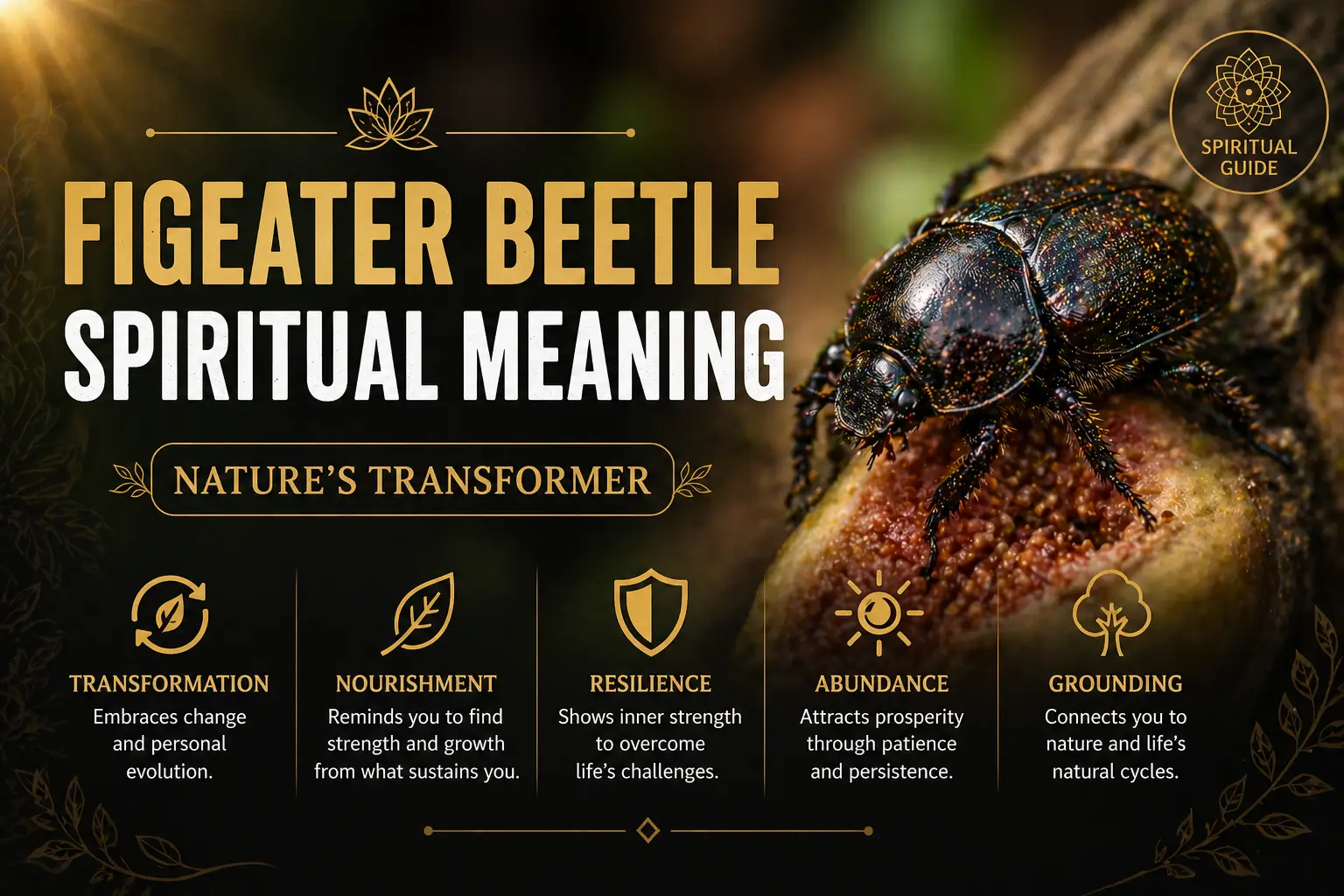
The figeater beetle carries deep spiritual meaning rooted in transformation, abundance, and renewal. Across cultures and traditions, this metallic green scarab is seen as a powerful symbol of growth, resilience, and divine guidance. If one has crossed your path, the universe may be sending a message worth paying attention to.
What Is the Figeater Beetle?
The figeater beetle, scientifically known as Cotinis mutabilis, is a member of the scarab beetle family Scarabaeidae. It is native to the southwestern United States and northern Mexico. Its striking metallic green body makes it one of the most visually memorable beetles in North America.
Adults grow up to 1.25 inches long and are most active during summer daylight hours. They feed primarily on ripe fruits like figs, peaches, plums, and berries. Their larvae, nicknamed “crawlybacks,” live underground and break down decaying organic matter, playing a vital role in soil health.
The beetle’s entire life cycle, from egg to adult, spans roughly one year. Adults live only one to two months, yet in that short time they feed, mate, and lay eggs in compost or decaying matter. This brief but purposeful life is itself a profound spiritual lesson.
The Core Spiritual Meaning of the Figeater Beetle
Transformation and Renewal
The figeater beetle’s life cycle is its most powerful spiritual teaching. It begins as an egg in the soil, becomes a larva feeding on decay, then pupates underground before emerging as a radiant winged adult.
This complete metamorphosis mirrors the human journey of spiritual growth. Darkness comes before the light. The underground phase represents inner work, processing old wounds, and building the foundation for new life.
The beetle reminds us: real transformation is not instant. It is patient, hidden, and deeply personal.
Abundance and Prosperity
The figeater beetle is strongly linked to abundance. It feeds on the ripest, most nourishing fruits of summer and is drawn to fertile, lush environments.
Spiritually, this signals that a season of harvest may be near. It encourages you to trust that your efforts will bear fruit, just as ripe figs eventually arrive after months of patient growth.
Seeing this beetle, especially near your home or garden, is often interpreted as a sign that prosperity is close or already present in your life.
Resilience and Inner Strength
Despite their clumsy flight and small size, figeater beetles are remarkably resilient. They navigate the world on their own terms, and their larvae move in an unusual upside-down crawl, adapting to survive.
This beetle teaches that there is no single “correct” way to move through life. Adapting your path, even if it looks unusual from the outside, is a sign of wisdom, not weakness.
Humility and Quiet Purpose
The figeater beetle lives without fanfare. It does not sting, does not harm humans, and goes about its role in the ecosystem quietly. This simplicity holds deep spiritual value.
It serves as a reminder that spiritual growth is not about external recognition. True progress often happens in the quiet, private moments of inner work and honest living.
Figeater Beetle Symbolism Across Cultures and Traditions
Ancient Egypt: The Sacred Scarab
The figeater beetle belongs to the scarab family, and this connection to ancient Egyptian spirituality is significant. The scarab beetle was one of the most sacred symbols in all of Egyptian religion.
According to ancient Egyptian belief, the god Khepri was depicted as a scarab-headed deity who rolled the sun across the sky each morning. His very name, derived from the Egyptian verb khpr, means “to come into being” or “to become.”
Scarab amulets were placed on the chests of the deceased during mummification to protect the heart and ensure safe passage into the afterlife. The scarab represented rebirth, resurrection, and the eternal cycle of life. As a member of this ancient family, the figeater beetle inherits this sacred symbolic legacy.
Native American Traditions
In many Native American cultures, beetles symbolize transformation, change, and adaptability. They are viewed as messengers of life’s cyclical nature, reflecting the rhythm of seasons, growth, and renewal.
Beetles that emerge from the earth, as the figeater does after its underground larval stage, carry special meaning. They represent crossing from one world into another, from darkness into light, from dormancy into full, vibrant life.
Ancient Greece
Ancient Greek thinkers who revered the natural world saw beetles as representatives of metamorphosis. The transformation from larva to winged adult was viewed as a physical demonstration of the soul’s capacity for evolution and growth.
The Greeks connected this change to philosophical ideas about the human spirit, which must pass through struggle and restriction before achieving its fullest expression.
General Western Spiritual Traditions
In modern Western spirituality, including Wicca and nature-based practices, the beetle is viewed as an Earth spirit and messenger. Green beetles in particular are associated with the element of Earth, healing energy, and the heart chakra.
Spotting one is often interpreted as encouragement to stay grounded, honor natural cycles, and trust the process of growth even when results are not yet visible.
Figeater Beetle Color Symbolism
Green (Most Common)
The signature metallic green of the figeater beetle is its defining spiritual color. Green is universally associated with growth, healing, balance, and new beginnings.
Seeing a green figeater beetle is a strong positive omen. It signals that healing is available to you, that growth is underway, and that harmony with the natural world is within reach.
Red Figeater Beetle
The red figeater beetle carries energy of passion, courage, and bold action. It is spiritually linked to the heart and to the drive that pushes people forward in love and creative pursuits.
If you encounter a red figeater beetle, it may be nudging you to take a brave step you have been avoiding, whether in a relationship, a creative goal, or a life decision.
Brown Figeater Beetle
Brown connects to grounding, home life, family, and stability. A brown figeater beetle appearing in your life may be a sign to slow down and focus on your foundation.
It reminds you that abundance often starts with appreciating what you already have. Family, routine, and a stable home are not small things but the soil in which everything else grows.
What It Means When a Figeater Beetle Appears
When It Lands on You
A figeater beetle landing on you is considered one of the strongest personal omens. It is seen as a direct message from the spiritual realm, often interpreted as a sign that love, transformation, or a new opportunity is entering your life.
Some traditions hold that when a beetle lands and stays on you without leaving quickly, it is drawing your attention to something important happening around you right now.
When You See One at Home
Spotting a figeater beetle near or inside your home is linked to domestic harmony, incoming abundance, and protection of your personal space. It is rarely seen as a negative sign.
It can also signal that this is a good time to focus energy on your home, family relationships, or the foundations of your daily life.
When You See One Repeatedly
Repeated sightings of the same type of beetle are rarely coincidences in spiritual interpretation. They are seen as the universe emphasizing a message that has not yet been received clearly.
If figeater beetles keep appearing in your life, pause and reflect. The message is likely about transformation or abundance, and it may require honest self-examination to fully understand.
When One Appears in a Dream
A figeater beetle appearing in a dream often signals spiritual awakening or personal growth in progress. Dreaming of a beetle crawling upward is associated with rising from a difficult period. Dreaming of one flying is linked to freedom, new possibilities, and forward momentum.
Figeater Beetle as a Spirit Animal and Totem
If the Figeater Beetle Is Your Spirit Animal
People guided by the figeater beetle spirit animal tend to be quietly resilient. They do their best work in private, find meaning in purposeful routine, and are deeply connected to nature and the earth.
They may not seek the spotlight, but their contributions matter. Like the beetle’s larvae, which silently enrich the soil, their behind-the-scenes efforts quietly make everything around them flourish.
Figeater Beetle as a Power Animal
Call on the figeater beetle as a power animal when you need strength to push through a transition. It is especially useful during periods of personal reinvention, career change, or healing from loss.
This beetle’s energy supports patience. It teaches that the most meaningful transformations happen slowly, beneath the surface, before they are ever seen by the outside world.
Figeater Beetle and Love
The figeater beetle carries gentle but meaningful energy in matters of love and connection. Its appearance during emotionally significant moments is often interpreted as guidance from the soul level.
For those in relationships, it may signal a time of deepening intimacy or healing past misunderstandings. For those who are single, it can represent an invitation to open the heart and welcome new connection.
Some spiritual traditions also link the figeater beetle to twin flame or soulmate energy, suggesting that when it appears, a meaningful soul-level meeting may be approaching or already present in your life.
Biblical and Abrahamic Perspectives
The figeater beetle is not directly referenced in scripture. However, beetles broadly appear in Leviticus 11:22 as part of lists of winged insects, and the Bible uses insects throughout its texts as symbols of natural order and divine design.
Themes connected to beetle symbolism, including resurrection, renewal, and the cycle of life, are deeply embedded in Abrahamic spiritual thought. The transformation from death to new life mirrors central themes in Christianity, Islam, and Judaism alike.
In Islam, all creatures are considered signs of Allah’s creation (ayat), and the intricate design and lifecycle of the beetle can be viewed as a reflection of divine wisdom and intentional design in the natural world.
Ecological Role as Spiritual Mirror
One angle many articles miss is the deep connection between the beetle’s ecological role and its spiritual meaning. The figeater beetle’s larvae break down decaying organic matter and return nutrients to the soil. This is not destruction but regeneration.
Spiritually, this mirrors how our own painful experiences, losses, and endings are not wasted. They become the compost from which new growth rises. Nothing is truly destroyed; it is transformed.
The adult beetle then feeds on the ripest, sweetest fruits and occasionally assists in pollination. This cycle from decay to abundance is the beetle’s life in full, and a perfect model of spiritual growth.
What To Do When You See a Figeater Beetle?
Pause and be present. The appearance of this beetle is a prompt to slow down and check in with yourself rather than rushing past it.
Reflect on these questions:
- What area of my life is currently in a stage of transformation?
- Am I being patient enough with my own growth?
- Is there something I need to release so something new can emerge?
Practical actions to honor the encounter:
- Journal your thoughts and feelings immediately after seeing the beetle
- Spend time in nature to ground the experience
- Meditate using the image of the beetle as your focus point
- Notice if the sighting coincides with any significant life event or decision
Resist the urge to overthink or force a specific interpretation. The meaning that feels most true to your own life at this moment is almost certainly the right one.
Key Takeaways
- The figeater beetle (Cotinis mutabilis) is a member of the ancient scarab beetle family, giving it a deep spiritual lineage stretching back to ancient Egypt.
- Its core spiritual meanings are transformation, abundance, resilience, and humility.
- As a scarab, it is connected to the Egyptian god Khepri, who represented rebirth and the rising sun.
- Its life cycle, from underground larva to winged adult, is a direct spiritual metaphor for human growth and evolution.
- Color matters: green signals healing and growth, red signals passion and courage, brown signals grounding and stability.
- When it appears repeatedly, the universe is emphasizing a message worth sitting with.
- Its ecological role as a decomposer and seed spreader mirrors the spiritual truth that nothing is wasted, everything transforms.
Frequently Asked Questions
Is the figeater beetle a good omen?
Yes, in most spiritual traditions the figeater beetle is considered a positive sign. It is associated with abundance, transformation, love, and growth. Very few traditions assign it a negative meaning.
What does it mean if a figeater beetle lands on my hand?
A beetle landing on your hand specifically is often linked to something you are creating or doing with your hands in life. It may be an encouragement to continue building, creating, or working toward a goal you have in progress.
Can the figeater beetle be a warning sign?
In some interpretations, a figeater beetle appearing during a period of stagnation or avoidance is a gentle warning to stop delaying transformation. It is not a sign of danger but a nudge toward necessary change.
How is the figeater beetle different from a June bug spiritually?
Both share themes of transformation, but the figeater beetle is more specifically linked to abundance, love, and grounding because of its close relationship with ripe fruit and rich soil. The June bug more broadly represents persistence and endurance.
Does the figeater beetle have meaning in Hoodoo?
While the figeater beetle is not a traditionally prominent symbol in Hoodoo, beetles and scarabs within African diaspora spiritual practices are broadly connected to ancestral protection, movement, and the clearing of negative energy. The black beetle in particular carries this protective energy in channeled interpretations.
What does it mean to dream of a figeater beetle flying?
A flying figeater beetle in a dream typically signals freedom, movement, and the arrival of a new phase of life. It suggests that whatever was holding you in place is beginning to lift and that you are ready to move forward.
Why does the figeater beetle make a loud buzzing sound?
The distinctive buzzing comes from the beetle’s unusual flight style. Because its hard wing covers (elytra) only partially open during flight, air rushes through in a way that creates a loud, bee-like sound. Spiritually, this sound is sometimes interpreted as a bold announcement of presence, a reminder not to ignore the signs placed in your path.
Is there a spiritual difference between seeing a figeater beetle in summer versus other times of year?
Figeater beetles naturally emerge in summer (July through September), so summer sightings are common. However, seeing one outside its typical season would be considered especially significant spiritually, a stronger, more deliberate sign worth serious reflection.
What does it mean if a figeater beetle dies in my presence?
In many traditions, a beetle dying in your presence is not a bad omen but a symbol of completion. Something in your life may be reaching its natural end, making space for a new cycle to begin. It reflects the same transformation theme the beetle carries in life.
Does the figeater beetle have meaning in feng shui or Eastern traditions?
Green beetles in Chinese and broader Asian symbolic traditions are associated with good fortune, vitality, and the renewal of chi (life energy). While the figeater beetle is not native to East Asia, its vibrant green color places it within the same symbolic family as other auspicious green insects in these traditions.
This article is intended for informational and spiritual exploration purposes. Interpretations vary across cultures, traditions, and individual experience. Always trust your own intuition when interpreting signs from nature.