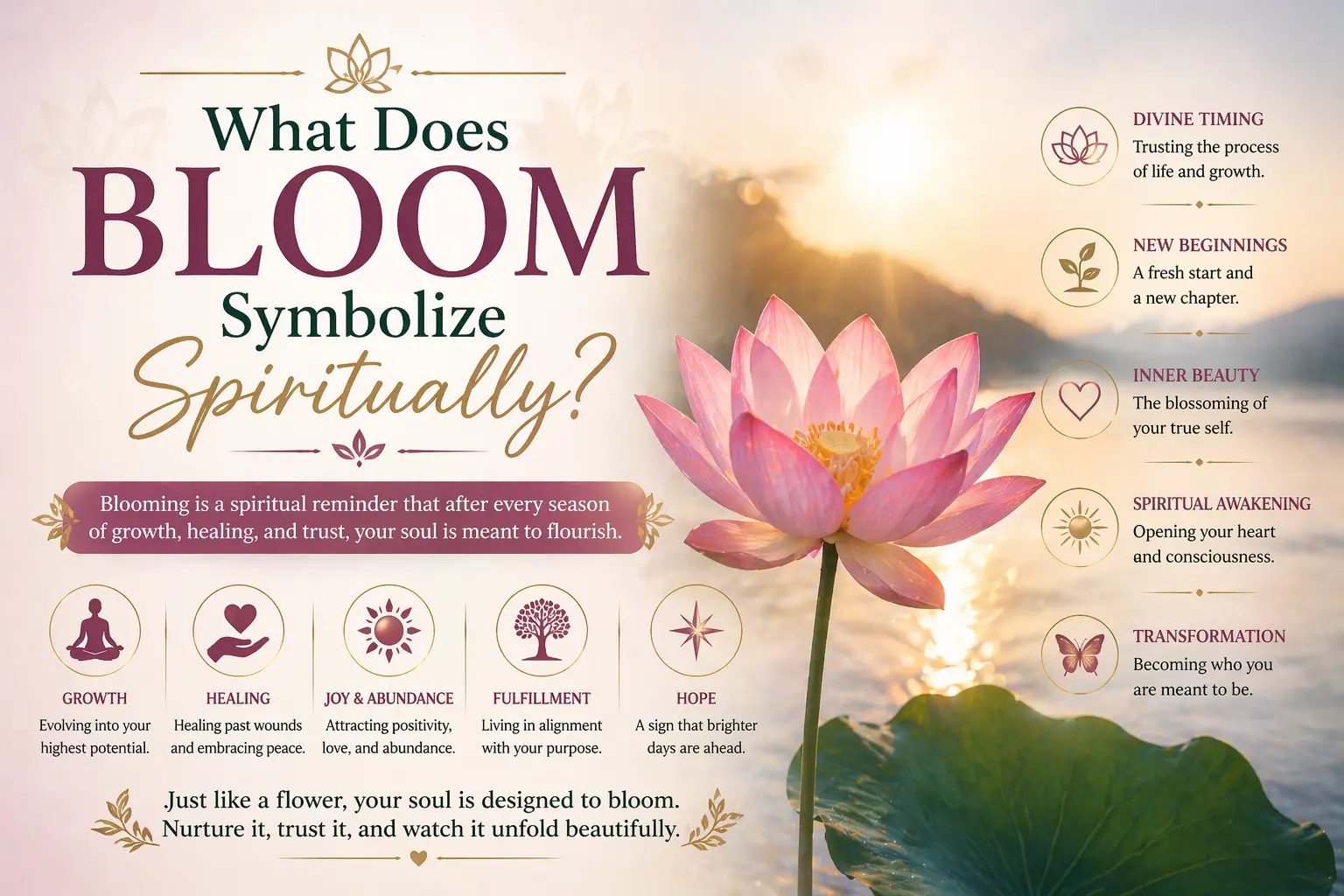
What Does Bloom Symbolize Spiritually?
Bloom symbolizes spiritual growth, awakening, and the unfolding of the soul. Across every major tradition on earth, a flower opening its petals represents the human spirit breaking free from darkness and rising into its highest potential. It is one of the most universal spiritual images in existence.
The Core Spiritual Meaning of Bloom
A bloom is more than a pretty flower. It is a living metaphor for transformation.
Spiritually, the act of blooming represents the journey from seed to full expression. That journey mirrors the soul’s own path, from dormancy and struggle, through to awakening and radiance.
Bloom also carries the idea of divine timing. A flower cannot be forced to open. It teaches patience, trust, and surrender to a higher rhythm.
Bloom as a Symbol of Spiritual Awakening
Many spiritual teachers describe awakening as a blooming. The soul, like a flower, contains everything it needs from the very beginning.
The trigger for awakening is usually a challenge. Just as flowers push through hard soil, the spirit often blooms most powerfully after difficulty and darkness.
This is why the phrase “you bloom where you are planted” carries such deep meaning. It points to the idea that your circumstances do not limit your spiritual potential.
Bloom in Buddhism: Rising Above Suffering
No symbol captures the spiritual meaning of blooming better than the lotus in Buddhism. The lotus grows in muddy water but emerges completely clean and radiant.
In Buddhist teaching, the lotus directly mirrors the path to enlightenment. The mud represents suffering and desire, while the open bloom represents nirvana, a state beyond all suffering.
The Lotus Sutra, one of Buddhism’s most important texts, states: “Just as a lotus flower grows out of the muddy water, yet remains untouched by the water, so do Bodhisattvas live in the world, untouched by the world’s impurities.” (Source: WisdomLib)
Different lotus colors carry different meanings in the Buddhist tradition. White represents mental purity, pink signifies divine love, and blue points to the path of wisdom.
The stages of the lotus bloom also matter. Each stage, from closed bud to open flower, corresponds to a different level of spiritual awakening.
Bloom in Hinduism: Devotion and Divine Creation
In Hinduism, blooming flowers are deeply tied to the divine. Major deities sit upon open lotus flowers, including Lakshmi, the goddess of prosperity, and Brahma, the god of creation.
The open bloom in Hinduism symbolizes purity and divine creation. It shows a soul or deity that is fully expressed, fully open, and untouched by negativity.
Flowers are offered in prayer ceremonies called puja as a gesture of devotion and gratitude. The act of placing a fresh bloom before a deity is a physical statement: “I am offering my most open and sincere self to you.” (Source: Balaji Nursery)
In Shaivism, the blooming flower is specifically used as an offering to Lord Shiva. It represents beauty, reverence, and the recognition of the sacred in the natural world.
In Jainism, the blooming flower symbolizes the beauty and joy of life, representing the contrast between happiness and sorrow in human existence.
Bloom in Christianity: Resurrection and New Life
The Bible uses flowering and blooming as powerful images of God’s action in the world. Isaiah 35:1 describes the desert rejoicing and blossoming, using the crocus as a symbol of divine restoration.
The lily is one of the most important blooms in Christian scripture. In the Song of Solomon, the lily is a metaphor for love and spiritual beauty. In the New Testament, lilies represent God’s provision and care.
Easter lilies bloom in spring and are used in churches to symbolize the resurrection of Christ. The white petals stand for purity and the promise of eternal life. (Source: Thursd)
The rose also holds great significance in Christian mysticism. It is associated with the Virgin Mary and with the Sacred Heart of Jesus. Monastery gardens throughout Europe were built around rose gardens as places of contemplation.
The almond tree, which blooms earlier than any other tree in the Holy Land, is used in the book of Jeremiah as a symbol of God’s watchfulness and the promise of hope after a long winter.
Bloom in Islam and Sufi Mysticism
In Islamic tradition, flowers represent the beauty and harmony of God’s creation. Floral patterns adorn mosques and sacred manuscripts as an expression of divine order and beauty.
The rose holds a special place in Islam. It is associated with the Prophet Muhammad (PBUH) and is seen as a representation of divine love. Persian and Ottoman poets used the rose as a central symbol for longing and spiritual beauty.
In Sufi mysticism, the rose is a metaphor for the human soul. It represents the soul’s longing for reunion with the Divine. The opening of the rose is the soul’s movement toward God. (Source: Ecoroses)
The tulip is another deeply significant bloom in Islamic culture. In Arabic, the letters of the word for tulip share their root with the letters of “Allah,” making it a subtle visual representation of the name of God in Ottoman art and architecture.
Sufi poets like Rumi used floral imagery extensively. A garden in full bloom was the poetic setting for the soul’s encounter with the beloved, meaning God. The garden was never just a garden in Sufi poetry. It was the interior landscape of the awakened heart.
Bloom in African Spiritual Traditions
In many African traditional spiritual practices, flowers are sacred offerings made to ancestors and deities. The act of placing a fresh bloom on an ancestral altar is a statement of remembrance and continued relationship.
The hibiscus is widely used in African spiritual traditions. It is associated with beauty, love, and the cycles of life. In some traditions, it is connected to feminine spiritual power.
The baobab flower is considered sacred in certain African traditions. It represents strength, resilience, and the connection between the living and those who have passed.
Flowers and blooming plants are symbols of life’s continuity. The bloom says: even after death, life continues. Even in dry seasons, beauty returns.
Bloom in Indigenous and Native American Traditions
For many Indigenous peoples of the Americas, flowers are gifts from nature and carry specific spiritual messages. Their appearance in the wild is never accidental.
The sunflower is especially sacred in several Native American traditions. It symbolizes harvest, spiritual alignment, and the relationship between the people and the sun. Its seeds provide food, and its face turns toward the light.
Wildflowers represent the spirit of the land itself. They are used in storytelling, ceremony, and as indicators of the health and balance of the natural world.
In Mesoamerican traditions, the marigold, or cempasúchil, holds one of the most powerful meanings. It is known as the “flower of the dead.” During Día de los Muertos, its bright orange petals and strong scent are believed to guide the souls of the departed back to visit the living. (Source: Anima Mundi Herbals)
Bloom in Wicca and Modern Pagan Traditions
In Wicca and earth-based spiritual practices, the blooming of flowers is directly tied to seasonal rituals and the movement of sacred energy.
Beltane, celebrated on May 1st, is one of the most important flower-focused festivals. It honors fertility, abundance, and the full blooming of the earth after winter. Flowers are used to decorate altars, maypoles, and sacred spaces.
Roses are placed on altars and used in intention work. Pink roses represent love and healing, white roses represent purity and new beginnings, and red roses are used for passion and energetic power.
Each flower is understood to carry a specific energetic vibration. Lavender calms and purifies. Violet heightens psychic awareness. The daisy supports inner child healing and new starts. (Source: Wicked Obscura)
In Celtic lore, violets were said to grow where the veil between the world of the living and the world of spirits was at its thinnest.
Bloom and the Chakra System
In energy healing traditions rooted in ancient Indian philosophy, the chakras are depicted as lotus flowers in different states of bloom. A closed chakra looks like a closed bud. An open, healthy chakra is a fully bloomed lotus.
The Crown Chakra, called Sahasrara, is depicted as a thousand-petaled lotus. When it opens, the practitioner is said to experience unity with divine consciousness. This is the ultimate spiritual bloom.
The Heart Chakra, Anahata, is depicted as a twelve-petaled green lotus. Its opening represents the capacity for compassion, forgiveness, and unconditional love. Pink flowers and rose energy are often used in heart chakra healing.
Different flowers connect to different energy centers. Yellow flowers and sunflowers connect to the Solar Plexus Chakra. Blue flowers relate to the Throat Chakra and the courage to speak one’s truth. White flowers align with the Crown Chakra and the pursuit of higher wisdom.
What Blooming Means for the Individual Soul
Bloom is not just a symbol about flowers or nature. It is about you.
Every person, in every tradition, is understood to carry spiritual potential within them, like a seed. The question every tradition asks is: will you bloom?
Blooming requires courage. A flower has to push against the weight of soil. Spiritual growth works the same way. It requires effort, patience, and the willingness to face what is uncomfortable.
Spiritual teachers across traditions emphasize this point: the bloom does not happen instantly. The Buddhist path is gradual. The Sufi journey is long. The Christian life of sanctification takes a lifetime.
The Zen proverb captures it beautifully: “The flower does not think of competing. It just blooms.” The soul’s work is not to compare itself to others, but simply to open.
Bloom as a Symbol of Impermanence
Every tradition that uses the bloom as a spiritual symbol also acknowledges its end. The flower opens, and eventually it fades. This is not a tragedy. It is a teaching.
In Japanese spiritual culture, the philosophy of mono no aware describes the bittersweet beauty of transient things. The cherry blossom, or sakura, is the purest expression of this. It blooms brilliantly for only days, then falls. That brief perfection is exactly what makes it sacred.
In Islam, the temporary nature of worldly pleasures is reflected in the flower’s short bloom. The Quran uses natural imagery to remind believers that only the divine is eternal.
In Christianity, Isaiah 40:6 reminds readers that “all people are like grass, and all their faithfulness is like the flowers of the field.” The bloom of life is real and beautiful, but it points toward something greater and permanent.
Bloom in Ayurveda and Traditional Chinese Medicine
Bloom carries spiritual meaning in healing traditions too, not just religious ones.
In Ayurveda, seasonal flowers like jasmine and rose are used for their connection to the heart and crown chakras. Jasmine is believed to cool the body and elevate the spirit. Rose is used for emotional healing and heart-centered connection. (Source: Anima Mundi Herbals)
In Traditional Chinese Medicine, the peony and magnolia are used to regulate qi, the vital life force that flows through the body. When qi flows freely, the person is in a state of spiritual and physical health.
These traditions do not separate the physical and spiritual. A flower that heals the body also heals the spirit. The bloom is medicine for both.
The Spiritual Meaning of Bloom by Color
Color significantly shapes what a bloom communicates spiritually. Here is a quick reference:
| Bloom Color | Spiritual Meaning |
|---|---|
| White | Purity, innocence, new beginnings, divine light |
| Red | Passion, divine love, life force, Shakti energy |
| Pink | Compassion, grace, heart chakra, emotional healing |
| Yellow | Wisdom, joy, solar energy, personal power |
| Purple / Violet | Psychic awareness, spiritual insight, mystical connection |
| Blue | Truth, divine wisdom, Throat Chakra, clarity |
| Orange | Vitality, creativity, sun energy, protection |
What Bloom Means in Dreams
When a bloom appears in a dream, most traditions interpret it as a spiritual message. It is rarely just a random image.
Seeing flowers in full bloom in a dream often signals spiritual awakening or a phase of personal growth beginning to manifest. It can indicate that something you have been working on is finally coming to fruition.
White flowers in dreams are widely interpreted as spiritual cleansing and the start of a new chapter. Red flowers point to grounded energy and life force. Yellow flowers suggest the light of wisdom arriving.
Dreaming of planting seeds that bloom quickly is understood as a sign of manifestation. Your intentions are aligning with the universe. The growth is imminent. (Source: Dreams Guidez)
In Islamic dream interpretation, flowers often represent blessings and good deeds. The Prophet Muhammad (PBUH) praised natural beauty, and seeing flowers in a dream may connect to the fitrah, the natural purity of the soul.
A dream of withering flowers is not necessarily negative. Many interpreters see it as a signal to let go of something that has completed its cycle so that new growth can begin.
An Angle Most Articles Miss: Bloom as Spiritual Permission
Here is something most articles do not say plainly: bloom is not just a metaphor. It is a permission.
Many people wait to express their authentic self, their gifts, their love, their creativity, because they feel they are not ready, or not worthy. The spiritual symbol of bloom challenges that directly.
A flower does not wait for the perfect moment. It blooms when its nature calls it to bloom. That is the invitation for the human soul as well.
Every tradition covered in this article conveys the same message in different language. Buddhism says awaken now. Sufism says turn toward the Divine now. Christianity says respond to grace now. The bloom is not about waiting. It is about opening.
What to Do: Practical Ways to Work with Bloom Symbolism
Bring fresh flowers into your space:
Choose a bloom that resonates with your current spiritual intention. A white lily for new beginnings, a rose for healing the heart, a sunflower for alignment with your purpose.
Use flowers in meditation:
Place a bloom in front of you during a meditation session. Focus on its layers and opening. Let it become a mirror for your own unfolding.
Create a floral altar:
Many traditions use flowers on sacred space. Arrange blooms with candles and meaningful objects to set a clear spiritual intention.
Observe the full life cycle:
Don’t throw away a flower the moment it begins to wilt. Watch it complete its cycle. Let it teach you about impermanence, change, and the grace of endings.
Work with flower essences:
Bach flower remedies and other floral essence systems use the energetic imprint of blooms for emotional and spiritual healing. Rose, cherry blossom, and lotus are commonly used.
Journal with bloom imagery:
Ask yourself: What in me is still a seed? What is ready to bloom? What has already bloomed and needs to be released?
Make an offering:
In the tradition that resonates with you, offer a fresh flower as an act of gratitude or devotion. The act of giving a bloom is itself a spiritual practice.
Key Takeaways
Bloom spiritually symbolizes awakening, transformation, and the soul’s unfolding potential. This meaning is confirmed across Buddhism, Hinduism, Christianity, Islam, African traditions, Indigenous practices, and modern spiritual paths.
The lotus is the most powerful bloom symbol, representing the rise from suffering to enlightenment. The rose represents divine love. The lily represents purity and resurrection. The marigold bridges life and death.
Color deepens the meaning. White signifies purity, red represents life force, yellow points to wisdom, and purple connects to mystical awareness.
Bloom also teaches impermanence. The flower’s short life is not a flaw. It is the lesson. All things are temporary, and their beauty is found in their transience.
The deepest spiritual message of bloom is this: every soul has the capacity to open fully, regardless of the mud it grows in.
Frequently Asked Questions
What does it mean spiritually when you see a flower blooming?
Seeing a flower bloom in real life or in a dream is widely understood as a sign of spiritual growth and positive change. Many traditions interpret it as confirmation that something new is beginning, an awakening, a relationship, a creative period, or a spiritual breakthrough.
Is bloom a symbol of hope?
Yes. Across cultures, the blooming flower represents hope, especially in winter or after hardship. In Christianity, the almond’s early bloom symbolizes God’s faithfulness. In Buddhism, the lotus rising from mud symbolizes the hope of liberation from suffering.
What does it mean when someone says “let your soul bloom”?
This phrase is an invitation to live authentically and express your fullest spiritual potential. It draws on the universal metaphor of the bloom to encourage openness, courage, and trust in one’s inner nature and divine timing.
Does bloom have a meaning in Hoodoo or rootwork traditions?
In Hoodoo and African American folk magic traditions, flowers and blooms are used in spiritual baths, floor washes, and altar work. Rose petals are used for love and attraction work. Lavender is used for peace and protection. Flowering plants placed in the home are believed to attract positive energy and blessings.
What does a blooming flower tattoo mean spiritually?
A blooming flower tattoo often symbolizes the wearer’s own spiritual awakening or a period of transformation they have survived or embraced. The lotus is the most popular choice for this reason, representing rising from hardship. A rose tattoo in spiritual contexts often represents divine love or the open heart.
What does it mean to dream of a garden in full bloom?
A garden in full bloom in a dream is one of the most positive spiritual dream symbols. It often indicates that a period of effort and patience is paying off, that your spiritual work is manifesting, or that a season of abundance and joy is arriving in your life.
Is there a connection between bloom and the divine feminine?
Yes. Many spiritual traditions associate blooming flowers with feminine divine energy. In Hinduism, Lakshmi sits upon a lotus. In Christianity, the rose is Mary’s symbol. In earth-based traditions, Beltane and spring festivals celebrate the blooming of the feminine aspect of the earth. The opening flower is a symbol of receptivity, creativity, and generative spiritual power.
What does a closed bud mean compared to an open bloom spiritually?
A closed bud represents potential, the divine gift that has not yet been expressed. An open bloom represents that same potential now fully realized. In chakra work, a closed chakra looks like a closed bud, while a fully functioning chakra is depicted as an open lotus. The journey from bud to bloom is the journey of spiritual development.
Why do so many religions use flowers in their rituals?
Flowers are universally available, naturally beautiful, fragrant, and short-lived. These qualities make them perfect spiritual symbols. Their beauty reflects the divine. Their fragrance represents the presence of the sacred. Their impermanence reminds worshippers of what truly matters. Every major world religion recognized these qualities independently, which is why flowers appear in temples, churches, mosques, and shrines across every culture.
Does blooming in autumn or winter hold a different spiritual meaning?
Yes. A flower that blooms out of season is often seen as a special spiritual sign. In many folk traditions, an unexpected bloom in winter or autumn represents divine favor, a supernatural message, or confirmation that something miraculous is unfolding. The very unlikeliness of the bloom amplifies its spiritual message.
Can a wilting flower have positive spiritual meaning?
It can. While wilting generally signals endings, grief, or depletion, many spiritual teachers point to the wilting flower as a teacher of acceptance and surrender. Letting go of what has completed its cycle is itself a spiritual act. The wilting flower prepares the ground for new growth.