What Does Snow Symbolize Spiritually?
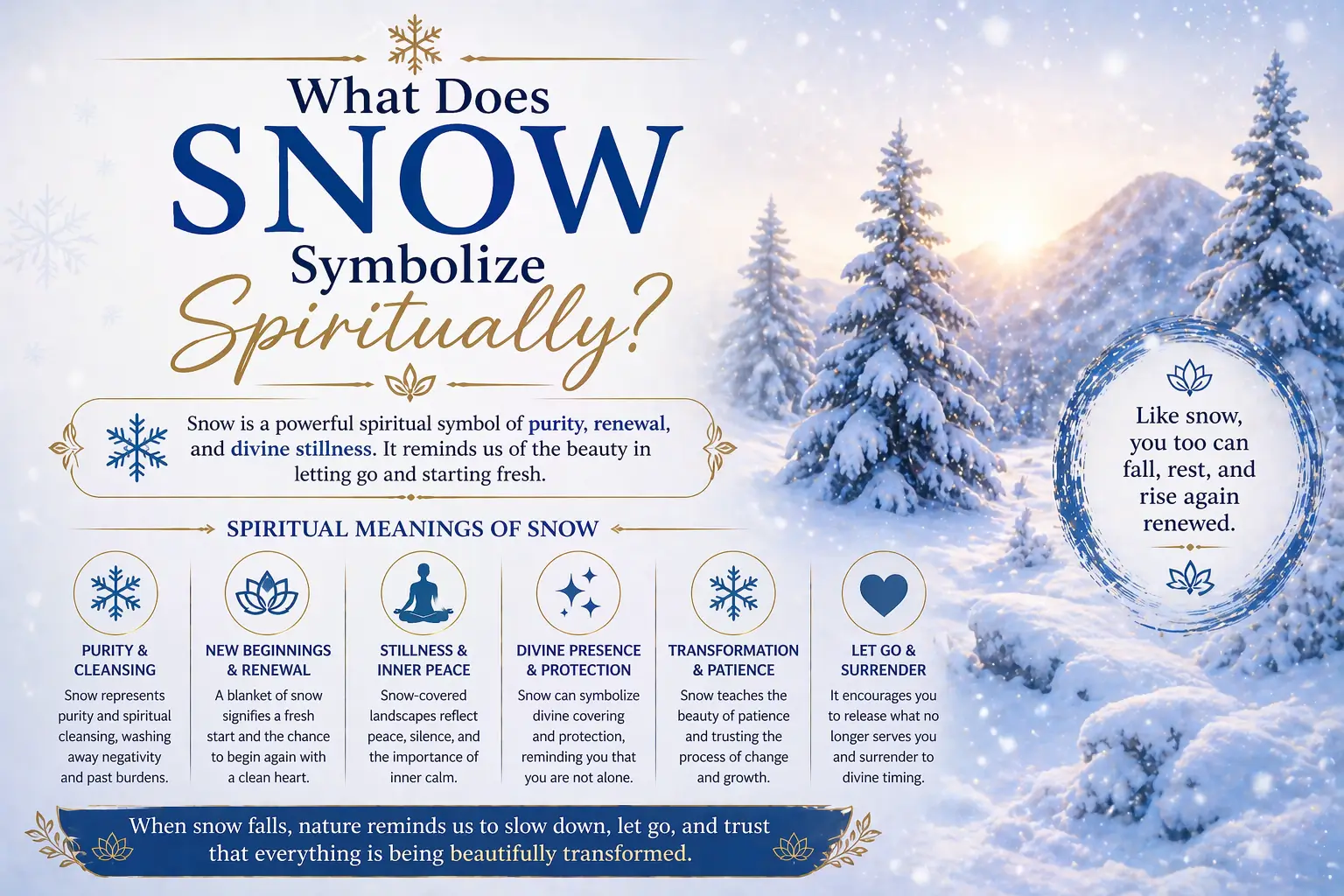
Spiritually, snow symbolizes purification of the soul and the sacred stillness that precedes transformation. Rooted in Shinto tradition, where the first snowfall is seen as divine cleansing, and echoed across Celtic mysticism, where snow marked the veil between worlds growing thin, it functions as what Jungian psychology calls a “liminal symbol”, a threshold image signaling the dissolution of one state of being before another emerges.
When the World Goes White, Something Shifts
There is a reason poets have always reached for snow when describing spiritual awakening.
The transformation is total. Sudden. One morning, the world you knew is simply gone.
Scientists estimate that fresh snow absorbs up to 90% of sound. Ancient peoples across the Northern Hemisphere read that silence as sacred interruption — not weather, but message.
The Ainu people of Japan, with roots stretching back at least 15,000 years, revered winter snowfall as the breath of mountain gods descending to earth. That instinct is one of the most consistent threads in all of human spiritual history.
📌 Important Note
Many people assume snow carries primarily dark or foreboding spiritual meaning. That is a significant oversimplification. Across most traditions, snow symbolizes renewal through stillness rather than finality. Even where snow is associated with endings, those endings are understood as necessary doorways. The spiritual weight of snow is almost universally hopeful at its core.
1. Purification and the Blank Slate
The most universal spiritual reading of snow is purification.
When snow falls, it covers the dirt, the decay, the clutter of the world beneath it. In Christian mystical tradition, this image appears directly in scripture. Isaiah 1:18 describes sins being made “white as snow” — using it as the definitive image of divine cleansing.
The logic is intuitive. Snow erases the visible record of what came before.
It speaks to the human longing for a genuine fresh start. Not just a psychological reset, but a cosmological one. Snow suggests that nature itself sometimes hits the reset button.
2. Silence as Sacred Space
Snow creates silence. Not the ordinary quiet of a calm afternoon, but something deeper and stranger.
Fresh snowpack traps sound waves inside its porous crystal structure. The world does not just get quieter. It gets different.
Many contemplative traditions treat this kind of silence as the precondition for spiritual encounter. Zen Buddhism frequently uses winter landscapes in its teaching imagery precisely because snow-silence mirrors the quality of an empty mind.
The haiku master Matsuo Bashō wrote winter scenes not as decoration but as direct pointers toward awakened awareness. In that tradition, you do not describe snow. You let snow describe you.
3. The Liminal Threshold in Celtic Tradition
The ancient Celts divided the year into the light half and the dark half.
At Samhain, the boundary between the living and the dead dissolved. Snow, appearing in this liminal season, was understood as part of that thinning veil.
It transformed the landscape into something unrecognizable. That was the point. Ordinary perception breaking down is exactly what a threshold feels like.
The World History Encyclopedia documents how Celtic peoples read environmental signs as communications from the Otherworld. A sudden snowfall could mark a sacred site or signal divine presence.
Whiteness itself, across Celtic symbolism, belonged to the realm of the supernatural.
4. Snow in Shinto: The Purity of Harae
In Shinto, purity is not merely a moral category. It is a metaphysical condition.
The concept of harae — ritual purification — permeates Shinto practice. Snow is understood as a natural enactment of it. Shrine priests in mountain regions have long read early snowfall as auspicious, a sign that the kami (divine spirits) are refreshing the sacred landscape.
The snow-covered image of Fushimi Inari Shrine in winter carries enormous weight for Japanese practitioners. It signals that the ordinary world has been briefly returned to its original, uncorrupted state.
5. Death, Dormancy, and the Promise Beneath
Snow buries. It covers the fields, the roots, the seeds.
And yet those seeds survive.
This tension between surface death and hidden life gives snow one of its richest spiritual registers. In agricultural spiritual traditions across Europe and Central Asia, snow cover was not mourned but welcomed as protective insulation.
The Norse understood this deeply. In their cosmology, winter was not the absence of life but its concentrated, resting form. The Norse mythological cycle, including the cataclysm of Ragnarök, ends not in permanent darkness but in a new earth rising from the waters, green and renewed.
6. Spiritual Meanings Across World Traditions
| Tradition | Primary Snow Symbolism | Associated Concept |
|---|---|---|
| Shinto (Japan) | Divine purification | Harae (ritual cleansing) |
| Celtic / Druidic | Liminal veil, threshold | Otherworld proximity |
| Christianity | Forgiveness, divine cleansing | Grace, absolution |
| Norse / Germanic | Protective dormancy | Cyclical death and rebirth |
| Zen Buddhism | Empty mind, clarity | Satori (sudden awakening) |
| Ainu (Japan) | Breath of mountain gods | Sacred natural communication |
| Native American | Spirit world presence | Ancestral visitation |
| Tibetan Buddhism | High-altitude clarity | Dzogchen pure awareness |
7. Snow as Spiritual Testing
Many traditions frame winter wilderness as a place of testing and stripping away.
The biblical forty days in the desert echo in countless winter retreat traditions across world religions. Snow isolates. It cuts off ordinary social life and forces introspection.
Celtic monastic communities between roughly 500 and 900 CE actively sought island hermitages and mountain cells where winter snow enforced the silence they craved.
The hardship was not incidental. It was the point. Isolation in snow teaches what comfort conceals.
8. White as the Color of the Divine
White occupies a complex position across spiritual traditions.
It is simultaneously the color of death shrouds in East Asian mourning and the color of angelic beings in Western religious imagery. It appears on the garments of initiates, priests, and those undergoing spiritual transition from ancient Egypt to contemporary Christianity.
National Geographic’s cultural research confirms how consistently white marks boundaries — between life and death, the sacred and profane, the known and the unknowable.
Snow, as the natural world’s great white phenomenon, carries all of that weight without trying.
9. Snow’s Spiritual Associations
| Association | Spiritual Meaning | Context |
|---|---|---|
| Freshly fallen snow | New beginning, divine reset | Universal / cross-cultural |
| Blizzard or snowstorm | Spiritual trial, disorientation | Mystical traditions |
| Melting snow | Release, grief transforming | Seasonal spiritual cycles |
| Snow on sacred sites | Divine blessing or presence | Shinto, Celtic, Native American |
| Footprints in snow | Accountability, the soul leaves a mark | Sufi and Christian mysticism |
| Avalanche | Sudden total transformation | Tibetan and mountain traditions |
| Ice beneath snow | Frozen emotion, concealed truth | Jungian symbolic reading |
10. Snow in Dreams and the Unconscious
Carl Jung wrote about winter landscapes as reliable dream symbols of psychological transition.
Snow in dreams frequently marks the presence of the Self archetype — the organizing center of the psyche beginning to emerge. Being buried in snow often signals that the ego is dissolving, frightening but necessary.
Walking through snow toward light typically represents conscious spiritual progress.
What strikes me is how the unconscious mind reached the same symbolic conclusions as ancient religion — independently, across cultures, across centuries.
11. Native American Perspectives on Sacred Snow
Among many Indigenous North American nations, snow carries direct spiritual communication.
The Lakota’s sacred figure of the White Buffalo Calf Woman ties the color white inseparably to purity, divine power, and sacred messenger status. Winter ceremonies conducted in snow are not held despite the conditions but because of them.
The Anishinaabe (Ojibwe) teach that winter is the time for stories — when the spirit world is most accessible and human beings are meant to listen rather than act.
Snow enforces this beautifully. You cannot farm in snow. You cannot wander far. What remains is the inward life, which these traditions treat as the truer one.
12. Snow in Sufi and Islamic Mystical Thought
In Sufi poetry, particularly the Persian tradition of Rumi in the 13th century, winter landscapes carry the ache of spiritual longing.
The bareness of a snow-covered world mirrors the state of the mystic emptied of ego and false attachments.
Rumi does not romanticize this. He describes it as painful and necessary. The snow, in his reading, is what the soul looks like after divine love has moved through it — stripped clean, quiet, and luminous.
There is loss in that image. There is also tremendous beauty.
Final Word
Snow asks something most of us resist. It asks us to stop.
To sit with what is quiet and bare and cold.
Every tradition that has grappled with snow has arrived at the same place: the world purified by white silence is not a lesser world. It is, in some sense, a more honest one.
What is covered is at rest. What remains visible are the essential forms of things — the outlines, the shapes, the bones of the world.
Perhaps that is snow’s deepest spiritual teaching. Beneath all the accumulation of ordinary life, the soul has a shape. And sometimes it takes everything going white and still before we can finally see it.