Spiritual Meanings of the 7 Colors of the Rainbow in the Bible
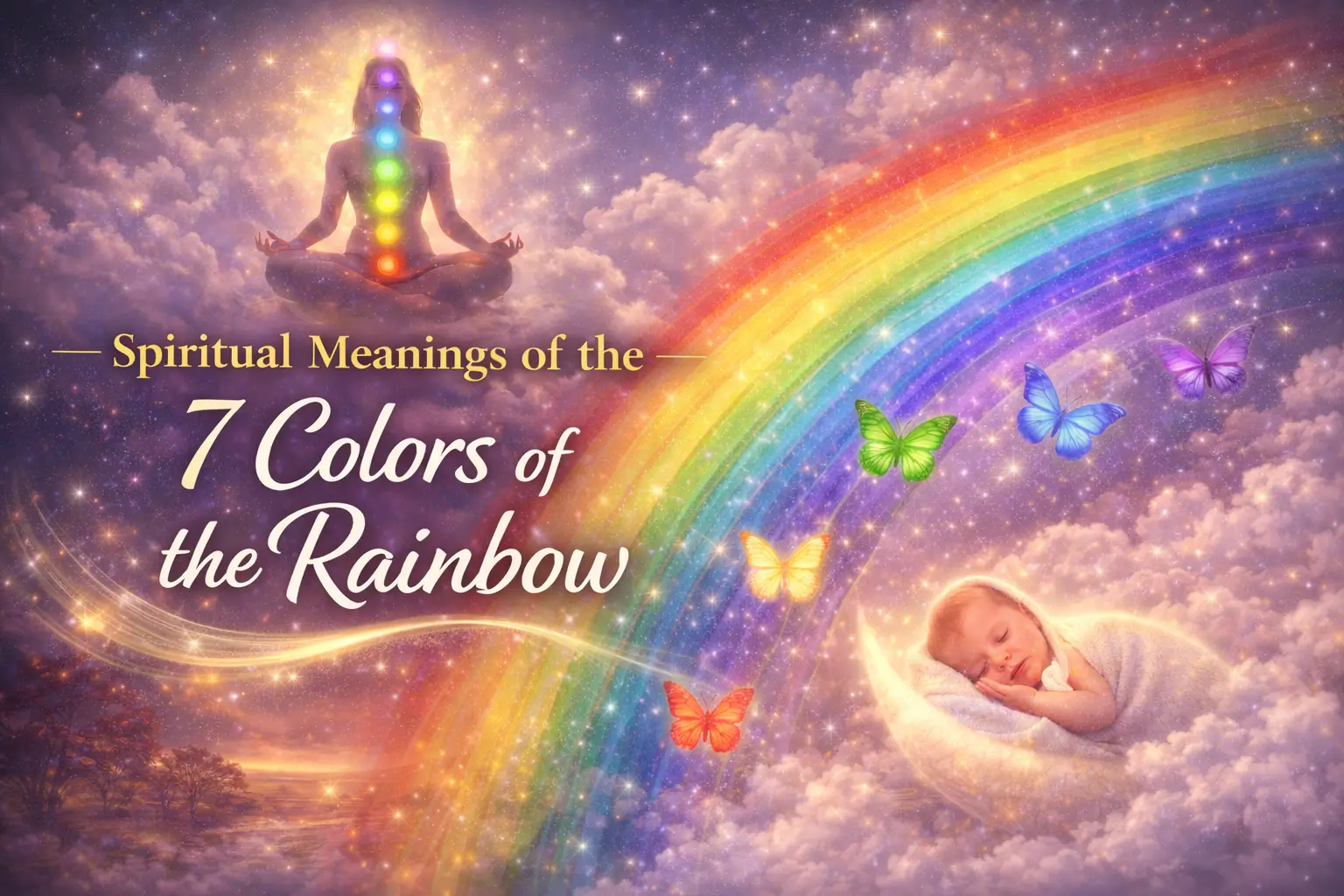
The 7 colors of the rainbow in the Bible — red, orange, yellow, green, blue, indigo, and violet — each carry unique spiritual meanings rooted in Scripture. Together, they represent God’s covenant with humanity, His redemptive nature, and the fullness of His divine promises. The rainbow first appears in Genesis 9:13 as God’s eternal sign to Noah that He would never again destroy the earth by flood.
Understanding these colors goes far deeper than a simple sign in the sky. Each color connects to specific biblical themes — from the blood of Jesus to divine healing, from heavenly royalty to spiritual wisdom. This article explores all 7 colors in detail, with scripture references, tradition-specific meanings, comparison tables, and practical takeaways for your faith journey.
What Does the Rainbow Mean in the Bible? A Historical and Spiritual Overview
The rainbow holds one of the most powerful positions in all of biblical symbolism. It first appears in the Book of Genesis, then again in Ezekiel and the Book of Revelation, each time in the presence of God’s glory.
The Rainbow in Genesis
After the great flood, God made an everlasting promise to Noah and all living creatures. He set His bow in the clouds as a visible reminder of that covenant. Genesis 9:13 (NIV) reads: “I have set my rainbow in the clouds, and it will be the sign of the covenant between me and the earth.”
This was not merely a meteorological event. It was a divine declaration. The rainbow became the first recorded symbol of God’s mercy in Scripture — a seal of His unbreakable word.
The Rainbow in Ezekiel
The prophet Ezekiel saw a vision of God’s glory surrounded by radiant light. Ezekiel 1:28 describes this as: “Like the appearance of a rainbow in the clouds on a rainy day, so was the radiance around him.” This vision connects the rainbow directly to the glory, majesty, and holiness of God.
The Rainbow in Revelation
In Revelation 4:3, the Apostle John sees a throne in heaven surrounded by a rainbow that looked like an emerald. This scene signals divine completeness and the eternal, all-encompassing nature of God’s presence. The rainbow in Revelation frames God’s throne with peace, not wrath.
The Number Seven and Its Biblical Significance
Seven is the number of divine completion and perfection in the Bible. The seven days of creation, the seven seals, the seven churches — all reflect wholeness in God’s plan. The seven colors of the rainbow (ROYGBIV) align with this pattern, suggesting that the full spectrum of light reflects the complete nature of God.
It is worth noting, as scholars at Answers in Genesis point out, that the rainbow is technically a spectrum of continuous color. The assignment of exactly seven distinct colors was largely popularized by scientist Isaac Newton, who divided visible light into seven bands. Their spiritual correspondence to Scripture is a matter of devotional reflection, not explicit biblical doctrine.
Rainbow Colors Across Traditions
Different faith traditions interpret rainbow colors in distinct ways.
| Tradition | View of the Rainbow | Notable Emphasis |
|---|---|---|
| Christianity (Biblical) | Covenant sign; God’s promise to Noah | Mercy, redemption, divine glory |
| Judaism | Everlasting covenant (brit olam); reminder of God’s judgment averted | Noah’s 7 laws; faithfulness |
| Islam | Only four colors recognized (blue, green, red, yellow); tied to the four elements | Natural phenomenon, not a covenantal sign |
| Native American (various tribes) | Bridge between spiritual and human worlds; healing symbol | Cherokee: hem of the Sun god’s coat |
| Mayan | Sign that the gods were no longer angry after destruction | Peace after divine wrath |
The 7 Colors of the Rainbow and Their Spiritual Meanings in the Bible
Red — The Blood, the Sacrifice, and God’s Love
Red is arguably the most theologically significant color in all of Scripture. The Hebrew word for red is oudem, meaning “red clay,” from which the name Adam is derived. This roots red in the very origin of humanity itself.
Red in the Bible represents the blood of Jesus Christ shed at Calvary. Colossians 1:20 speaks of peace made “through his blood, shed on the cross.” The color red is God’s most visible declaration of love — a love that cost everything.
In the Old Testament, red also pointed to atonement. Leviticus 17:11 teaches that “the life of a creature is in the blood.” Animal blood was required to atone for sin. When Jesus shed His blood on the cross, He became the final, perfect sacrifice that ended that requirement forever.
Red also appears in Isaiah 1:18, one of the most powerful verses about redemption: “Though your sins are like scarlet, they shall be as white as snow.” Here red represents sin — and God’s power to remove it completely.
Key spiritual meanings of red:
- The blood and sacrifice of Jesus Christ
- God’s passionate, unconditional love for humanity
- Atonement, redemption, and forgiveness of sin
- The life force within every human being
Orange — The Fire of God and the Holy Spirit
Orange does not appear explicitly by name in most Bible translations. However, its spiritual meaning is drawn from its composition — a blend of red (flesh and blood) and yellow (trials and God’s presence). This combination produces the color of fire.
Fire carries enormous spiritual weight in Scripture. In Acts 2:3, the Holy Spirit descends on the disciples as “tongues of fire.” This event — Pentecost — transformed a group of fearful followers into bold proclaimers of the gospel. Orange captures that same burning zeal.
The Fire of God in the Bible purifies as much as it empowers. Malachi 3:2-3 describes God as “a refiner’s fire” who will purify the Levites. Orange, as the color of that refining flame, speaks of a God who does not destroy His people but cleanses and strengthens them.
Key spiritual meanings of orange:
- The fire and power of the Holy Spirit
- Divine deliverance and passionate praise
- God’s refining and purifying process
- Spiritual boldness and zeal
Yellow — Divine Glory, Joy, and Trials of Faith
Yellow is linked in Scripture to gold — one of the Bible’s most important spiritual symbols. The Hebrew word charuts (gold) appears throughout the Old Testament to represent God’s sovereignty and majesty. Yellow captures that same radiance and divine light.
In 1 Peter 1:7, the trial of faith is compared to gold refined by fire — it is “of greater worth than gold.” Yellow therefore speaks of a faith that has been tested and proven. It is the color of perseverance, of a believer who has walked through fire and still stands in God’s presence.
Yellow also points toward the joy of God’s presence. Psalm 16:11 says, “In your presence there is fullness of joy.” The brightness of yellow reflects the overwhelming delight of standing in the light of God. It is not a passive joy — it is a radiant, life-altering gladness.
Key spiritual meanings of yellow:
- The glory and majesty of God
- Faith refined through trials
- Divine joy and the presence of God
- Heaven and the spiritual world
Green — Life, Immortality, and Spiritual Growth
Green holds a vivid place in biblical imagery. It is the color of living plants, of flourishing fields, and of life itself. Psalm 1:3 describes the righteous person as “like a tree planted by streams of water, which yields its fruit in season and whose leaf does not wither.” That evergreen leaf is one of Scripture’s great pictures of spiritual vitality.
Biblically, green is formed by combining yellow (trials and God’s presence) and blue (the Word of God and healing). This combination yields a color that speaks to spiritual growth through God’s Word and the endurance of faith through hardship. Green is not passive — it is the result of deep roots.
Green also symbolizes resurrection. Each spring, new life emerges from what appeared dead throughout winter. This natural cycle mirrors the central promise of Christianity — death is not the end. Green reminds believers that God is always in the business of bringing new life from old graves.
Key spiritual meanings of green:
- Life, immortality, and spiritual flourishing
- Resurrection and renewal
- Spiritual growth through God’s Word
- Rest, provision, and God’s pastoral care (Psalm 23)
Blue — The Healing Power of God and the Word of God
Blue is one of the most frequently used colors in the Old Testament, particularly in the design of the Tabernacle and priestly garments. The Hebrew word tekelet (blue) was the color of the fringe on the hems of priests’ robes. Numbers 15:38-40 commanded this specifically — blue on the hem as a reminder of God’s commandments.
Blue carries a direct connection to divine healing in the New Testament. In Matthew 9:20-22, the woman who had bled for twelve years reached out and touched the hem of Jesus’s garment and was instantly healed. That hem — blue in color according to Old Testament law — became the point of contact for a miracle. Blue is the color where heaven meets human need.
The very fact that the sky is blue, many biblical scholars note, speaks to the ever-present reminder of God’s heavenly realm above. Blue is associated with the Word of God itself — steady, vast, unchanging, and life-giving. The color speaks of divine truth that stretches beyond the horizon.
Key spiritual meanings of blue:
- The healing power of God
- The Word of God and divine truth
- Heaven and God’s majesty
- Priestly intercession and holiness
Indigo — Spiritual Wisdom, Royalty, and Divine Knowledge
Indigo sits between blue and violet in the spectrum, making it one of the most debated colors in the rainbow. Scientists have long questioned whether it deserves its own distinct band. Spiritually, however, its in-between position makes it powerful — it represents the bridge between the earthly (blue) and the divine (violet).
In biblical tradition, deep blue and purple shades were associated with royalty and priestly authority. Ezekiel 23:6 uses the word tekelet in a way that is sometimes translated as purple or violet, showing the close relationship between these hues in the ancient world. Indigo carries the weight of both royal identity and spiritual depth.
Indigo points to the pursuit of heavenly wisdom — the kind that comes from deep prayer, fasting, and time in God’s presence. Proverbs 8:17 says, “I love those who love me, and those who seek me diligently will find me.” Indigo, as a color of depth and inward reflection, represents the posture of a soul that presses past the surface to find God.
Key spiritual meanings of indigo:
- Spiritual wisdom and divine knowledge
- The bridge between earth and heaven
- Deep intercession and prayer
- Royal identity in Christ
Violet (Purple) — Royalty, Priesthood, and Divine Authority
Violet, also interpreted as purple in many biblical contexts, is the final arc of the rainbow and carries immense spiritual significance. Purple was historically the most expensive dye in the ancient world — extracted from sea snails and reserved for kings and emperors. The Bible uses this color consistently to denote royalty, priesthood, and divine authority.
In the tabernacle, purple was one of three key colors woven into the curtains and priestly garments (Exodus 26:1). The combination of these colors — blue (heaven/Word of God), purple (royalty/priesthood), and scarlet (blood/sacrifice) — told the full story of Jesus as High Priest, King, and Savior.
Revelation 17:4 and other passages use purple to identify positions of high power, both earthly and spiritual. For believers, violet is a reminder of their identity as “a royal priesthood” (1 Peter 2:9). It speaks of the dignity and authority that God places on every person who comes into relationship with Him.
Key spiritual meanings of violet/purple:
- Royalty and divine authority
- The priesthood of all believers
- Wealth of God’s kingdom
- Mercy, compassion, and the grace of God
The 7 Colors Compared: Biblical Meanings at a Glance
| Color | Hebrew/Greek Link | Primary Biblical Meaning | Key Scripture |
|---|---|---|---|
| Red | Oudem (red clay) | Blood of Christ; atonement; God’s love | Isaiah 1:18; Colossians 1:20 |
| Orange | Blend of red + yellow | Fire of the Holy Spirit; divine deliverance | Acts 2:3; Malachi 3:2-3 |
| Yellow | Charuts (gold) | God’s glory; faith refined; divine joy | 1 Peter 1:7; Psalm 16:11 |
| Green | Blend of yellow + blue | Life; resurrection; spiritual growth | Psalm 1:3; Psalm 23:2 |
| Blue | Tekelet (blue/violet) | Healing; Word of God; heaven | Numbers 15:38; Matthew 9:20 |
| Indigo | Between blue + violet | Spiritual wisdom; royalty; intercession | Proverbs 8:17; Ezekiel 1:26 |
| Violet/Purple | Royal dye; priesthood | Divine authority; royalty; mercy | 1 Peter 2:9; Revelation 4:3 |
The 7 Colors and Their Connection to God’s Names
Some biblical scholars and theologians connect the 7 rainbow colors to the 7 redemptive names of God. This is a devotional framework — not strict doctrine — but many believers find it meaningful.
| Color | God’s Redemptive Name | Meaning |
|---|---|---|
| Red | Jehovah-Tsidkenu | The Lord Our Righteousness |
| Orange | Jehovah-Mephalti | The Lord My Deliverer |
| Yellow | Jehovah-Shammah | The Lord Is There |
| Green | Jehovah-Rapha | The Lord Who Heals |
| Blue | Jehovah-Nissi | The Lord My Banner |
| Indigo | Jehovah-Rohi | The Lord My Shepherd |
| Violet | Jehovah-Jireh | The Lord Will Provide |
This table is a tool for reflection and prayer, not a dogmatic teaching. It helps many believers use the sight of a rainbow as a moment of spiritual proclamation and worship.
What Each Rainbow Color Means Across Different Spiritual Traditions
The Bible is not the only tradition that assigns meaning to rainbow colors. Here is how three major traditions differ.
| Color | Biblical Christianity | Jewish Tradition | Islam |
|---|---|---|---|
| Red | Blood of Christ; atonement | Life; covenant blood | Associated with fire |
| Orange | Holy Spirit fire; praise | Passion; festivity | Part of fire element |
| Yellow | God’s glory; divine joy | Torah light; wisdom | Associated with the sun |
| Green | Life; resurrection; growth | Fertility; new life | Highly sacred; paradise |
| Blue | Healing; Word of God; heaven | Tekhelet; divine law | Sacred sky color |
| Indigo | Spiritual wisdom; royalty | Deep reflection | Not separately identified |
| Violet/Purple | Royal priesthood; authority | Royalty; priesthood | Not separately identified |
8 Common Scenarios: What It Means to See a Rainbow Spiritually
Seeing a Rainbow After a Difficult Season
A rainbow after a storm is one of the most personal spiritual experiences many believers report. It mirrors the Genesis account almost exactly — hardship followed by a divine promise. When you see a rainbow after grief, loss, or struggle, Scripture invites you to receive it as God’s reminder that He has not forgotten you.
The story of Noah was one of total devastation before restoration. God did not remove the flood from Noah’s memory — He set His bow above it. The rainbow does not erase the pain; it reframes it within the context of God’s faithfulness and His bigger plan.
Seeing a Double Rainbow
A double rainbow is a natural phenomenon where light refracts twice inside water droplets, creating a second, reversed arc above the first. Some believers see this as a double portion of God’s blessing or promise. While Scripture does not address double rainbows directly, the concept of double blessing appears in passages like Isaiah 61:7.
There is no need to read doctrinal certainty into a double rainbow. However, if you are a person of faith walking through a season of waiting, a double rainbow can be a beautiful reminder that God’s promises are layered and abundant. Use it as a prompt for gratitude and prayer.
Seeing a Rainbow on Your Birthday
Several spiritual communities interpret a rainbow appearing on one’s birthday as a deeply personal sign. In the Bible, God often used specific moments — the right time, the right place — to deliver His messages. Think of the burning bush appearing precisely when Moses was near it (Exodus 3:2).
If you see a rainbow on your birthday, it can be taken as an invitation to reflect on God’s promises over your life in this new year. It does not guarantee anything specific. But it can be a meaningful moment to surrender the year ahead to God and trust His plan for your next chapter.
Dreaming of a Rainbow
Dreams hold significant spiritual weight in Scripture. God spoke to Joseph, Solomon, and Daniel through dreams. A rainbow in a dream, particularly for a believing Christian, may carry the same covenant symbolism as a physical rainbow — a promise of peace, hope, and divine presence.
Biblical wisdom cautions against over-interpreting dreams as direct prophetic messages. However, Proverbs 29:18 reminds us that “where there is no vision, the people perish.” A rainbow dream can renew your spiritual vision and stir up hope in seasons of discouragement.
Seeing a Rainbow in Church or During Worship
Many believers testify to seeing rainbows of light appear in the worship space through stained glass or natural refraction during prayer. Whether this is a natural phenomenon or a spiritually charged moment depends on your theological tradition. Either way, the biblical precedent — Ezekiel and John both saw rainbow imagery in God’s presence — makes it a meaningful symbol during worship.
The rainbow in Revelation 4:3 surrounds God’s throne. Seeing rainbow light during worship can be a reminder that you are approaching the very throne of grace. Hebrews 4:16 urges believers to come boldly to that throne. A rainbow in worship can function as an invitation to do exactly that.
Using Rainbow Colors in Prayer or Intercession
Some prayer traditions use colors as visual anchors during intercession. Colored candles, ribbons, or cloth in red, orange, yellow, green, blue, indigo, and violet are used to pray through specific themes — blood-bought redemption, Holy Spirit fire, God’s glory, healing, and so on. This is more common in charismatic and prophetic prayer circles.
This practice is not prescribed in Scripture but draws from the broad tradition of using visual symbols in faith — just as the tabernacle was filled with specific colors carrying spiritual meaning. It is a tool, not a requirement. If it helps you focus your prayer, it can be a meaningful practice.
Teaching Children About the Rainbow in the Bible
The rainbow is one of the most accessible Bible stories for children. The story of Noah, the flood, and God’s promise is vivid, visual, and emotionally compelling. Teaching children that each color has a meaning gives them a richer connection to the story than the narrative alone.
Start simply — red for Jesus’s love, green for new life, blue for healing, purple for God’s kingship. As children grow, you can add layers of scriptural depth. The rainbow becomes a teaching tool that engages imagination and builds theological understanding at the same time.
Seeing a Rainbow During Grief or After Loss
Many people experiencing deep grief report that a rainbow appears at a significant moment — during a funeral, on the anniversary of a loved one’s passing, or at the precise moment they feel most alone. This experience is widely reported across cultures and religions.
From a biblical standpoint, the rainbow is God’s sign of covenant love. Isaiah 49:15-16 records God saying He will not forget His children, even more surely than a mother cannot forget her nursing child. A rainbow in grief does not undo the loss. But it can be a tender reminder that God sees the pain and His love endures beyond the reach of death.
What To Do When You See a Rainbow: A Practical Spiritual Guide
Seeing a rainbow is a natural event — but it can also be a spiritual moment if you know what to do with it. Here are practical steps rooted in Scripture.
Pause and acknowledge it:
Do not scroll past it on your phone. Stop, look up, and simply be present. Psalm 46:10 says, “Be still, and know that I am God.” A rainbow is a built-in invitation to stillness.
Speak God’s promises aloud:
The Hebrew tradition of spoken proclamation is powerful. When you see a rainbow, speak Genesis 9:13 out loud. Remind yourself — and the atmosphere — that God keeps His word. Speaking God’s Word activates faith (Romans 10:17).
Pray through the colors:
If you have time, pray a brief prayer connecting each color to a spiritual theme. Red — thank God for the blood of Jesus. Blue — pray for healing in your family. Green — ask for new life in a dead situation. This turns a fleeting sighting into a meaningful encounter.
Write it down:
Keep a spiritual journal. Record when you see a rainbow, what you were going through, and what you felt. Over time, you may see a pattern of God’s timing in those moments. Habakkuk 2:2 says to “write the vision and make it plain.”
Share it with someone:
The rainbow was given to Noah as a communal sign — for him, his family, and all living creatures. Share the moment with someone who needs hope. A photo, a message, or a simple word can carry the covenant meaning forward.
Key Takeaways
The rainbow is one of the most rich and layered symbols in all of Scripture. It is not just a weather event — it is a divine signature.
Here is a concise summary of what each color means biblically:
- Red — Blood, sacrifice, redemption, and God’s love through Christ
- Orange — The fire of the Holy Spirit, deliverance, and bold praise
- Yellow — God’s glory, divine joy, and faith refined through trials
- Green — Life, resurrection, growth, and God’s provision
- Blue — Healing, the Word of God, heaven, and priestly intercession
- Indigo — Spiritual wisdom, deep prayer, and royal identity in Christ
- Violet — Divine authority, the royal priesthood, and God’s mercy
Together, these seven colors form one complete picture of God — His nature, His covenant, His redemptive plan, and His eternal presence. When you see a rainbow, you are seeing a visual sermon. It preaches without words.
The rainbow does not belong to any one tradition or theology. It belongs to the God who set it in the clouds — and it remains His promise to every living thing on earth.
Frequently Asked Questions (FAQs)
1. What does the rainbow represent in the Bible?
The rainbow is God’s covenant sign given to Noah in Genesis 9:13 after the great flood. It represents God’s promise to never again destroy the earth with a flood. It also symbolizes God’s mercy, faithfulness, and the fullness of His glory, as seen in the visions of Ezekiel (1:28) and John in Revelation (4:3).
2. Are the 7 colors of the rainbow specifically mentioned in the Bible?
No. The Bible does not explicitly name the seven colors of the rainbow. The rainbow is described as a sign of the covenant but not broken into seven specific colors in Scripture. The seven-color framework (ROYGBIV) comes from Isaac Newton’s division of visible light. Believers apply individual color meanings drawn from broader biblical color symbolism to the rainbow as a devotional practice.
3. What is the spiritual meaning of red in the rainbow?
Red in the Bible is linked to the blood of Jesus, atonement, and God’s love. The Hebrew word oudem (red clay) is the root of the name Adam, connecting red to humanity itself. Isaiah 1:18 uses red/scarlet as a symbol of sin that God promises to make white as snow — pointing to the power of divine forgiveness.
4. What does blue mean spiritually in the Bible?
Blue, called tekelet in Hebrew, is the color of priestly garments and the hems of Jewish robes (Numbers 15:38). It represents the Word of God, divine healing, and heaven. When the bleeding woman touched the hem of Jesus’s garment in Matthew 9:20-22, she touched that blue border — and was healed instantly.
5. What does purple or violet mean in the Bible?
Purple represents royalty and priestly authority. It was used in the tabernacle (Exodus 26:1) and reserved for kings and the wealthy in the ancient world. For Christians, 1 Peter 2:9 declares that all believers are a “royal priesthood” — making purple their spiritual identity as well. Violet/purple is also associated with mercy and compassion.
6. Is there a connection between the rainbow and the Holy Spirit?
Yes, in a devotional sense. The seven colors of the rainbow correspond with Isaiah 11:2-3, which lists seven attributes of the Spirit of God — wisdom, understanding, counsel, power, knowledge, fear of the Lord, and delight in the Lord. Some teachers connect these seven qualities to the seven rainbow colors. This is not an explicit biblical teaching, but it is a meaningful framework used in charismatic and prophetic traditions.
7. What does it mean when you see a rainbow after a storm spiritually?
Seeing a rainbow after a storm mirrors the exact sequence in Genesis — hardship, then God’s promise. Spiritually, it can be received as God’s reminder of His faithfulness. It does not indicate that all problems are resolved, but it points to the covenant-keeping character of God. Use the moment to speak God’s promises aloud, pray, and renew your trust in His plan.
8. How do other religions interpret rainbow colors differently from Christianity?
Islam recognizes only four rainbow colors — blue, green, red, and yellow — connected to the four elements (water, earth, fire, and air). It does not assign the same covenantal significance as the Bible does. Judaism places great importance on the rainbow as the sign of the brit olam (everlasting covenant), closely tied to Noah’s Seven Laws for all humanity. Native American traditions, varying by tribe, often interpret the rainbow as a bridge between the physical and spiritual worlds, or as a symbol of healing — distinct from the biblical covenant framework.
For further reading on biblical color symbolism, visit BibleStudy.org’s Color Symbolism Series, the CrossExamined Reference Guide to Biblical Colors, or Christianity.com’s overview of color significance in Scripture.