What is the Spiritual Meaning of Eastern Eyed Click Beetle?
The Eastern Eyed Click Beetle carries a powerful spiritual message. It symbolizes divine protection, personal transformation, inner strength, and heightened awareness. When you encounter this beetle, it is widely believed to be a sign that you are being watched over, guided through change, and called to trust your instincts.
What Is the Eastern Eyed Click Beetle?
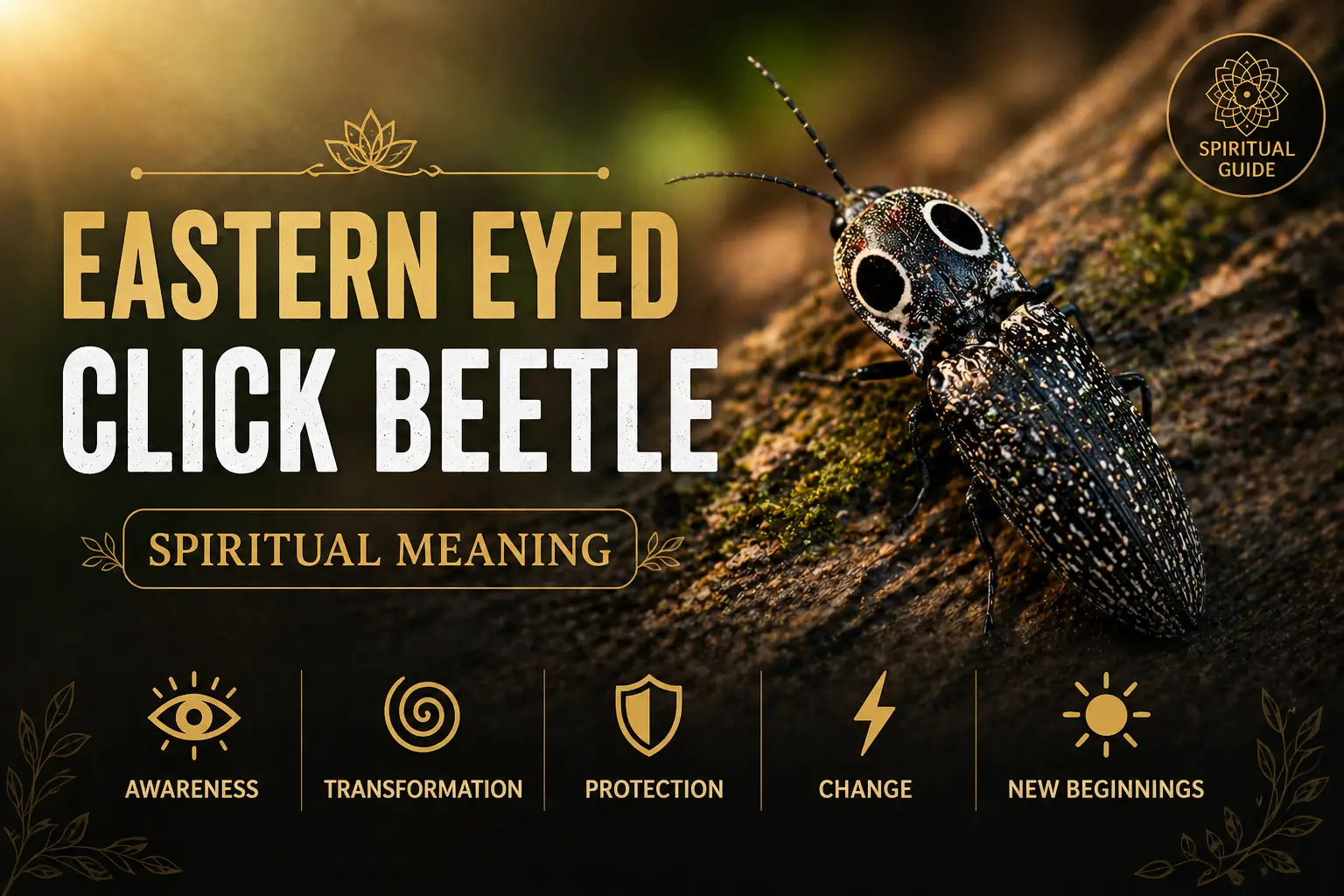
The Eastern Eyed Click Beetle, scientifically known as Alaus oculatus, is a large beetle native to North and Central America. It measures between 25 to 45 millimeters in length, making it one of the largest beetles in its family.
Its most striking feature is the pair of large, oval black spots on its thorax, ringed in white. These false “eyes” give the beetle its name and serve as a defense mechanism, startling predators into thinking they face something much larger.
The beetle belongs to the family Elateridae, commonly known as click beetles. It can propel itself into the air using a spine-and-groove mechanism in its thorax, producing an audible clicking sound. This physical ability is central to much of its spiritual symbolism.
The Core Spiritual Meaning of the Eastern Eyed Click Beetle
At its core, this beetle represents five major spiritual themes:
- Protection from unseen spiritual forces
- Transformation through life’s natural stages
- Resilience in the face of sudden challenges
- Awareness and sharpened intuition
- Uniqueness and embracing your true self
Each of these themes connects directly to the beetle’s biology. Its false eyes represent spiritual protection you may not see. Its clicking jump represents the courage to rise after falling.
Spiritual Symbolism of the False Eyes
The large black eyespots on the beetle’s back are not real eyes. They are a form of self-mimicry, where one part of the body mimics another to confuse predators.
Spiritually, these false eyes carry a profound message. They remind us that divine protection often works in ways we cannot see or understand. You are being guarded even when you feel alone.
They also warn us not to judge situations by surface appearances. Things are rarely what they first seem. The false eyes teach discernment, asking you to look deeper before reacting.
Many spiritual traditions interpret eye symbolism as the “all-seeing” presence of a higher power. In this context, the beetle’s spotted back becomes a sign that God, the universe, or your ancestors are watching over your path.
The Clicking Mechanism: Rising After Every Fall
The beetle’s clicking jump is biologically remarkable. When flipped onto its back, it arches its body and releases stored energy through a spine on its thorax, launching itself into the air and landing on its feet.
Spiritually, this action is one of the most powerful symbols the beetle offers. It is a direct metaphor for resilience. No matter how hard life knocks you down, you have the inner mechanism to rise again.
This quality resonates deeply across many belief systems. Whether through faith, willpower, or spiritual practice, the message is the same. The ability to recover is already built into you.
When you see this beetle, it may be a timely reminder to stop staying down. Like the beetle, your next move is to click, launch, and land on your feet.
Life Cycle and Transformation Symbolism
The Eastern Eyed Click Beetle undergoes complete metamorphosis. It begins as an egg, then spends several years as a larva (wireworm) inside decaying logs, before pupating and emerging as a fully developed adult.
This multi-year journey through darkness before emergence is deeply symbolic. It teaches that meaningful transformation is not instant. Growth happens in unseen stages, underground, out of the spotlight.
The larval stage, though hidden, is purposeful. The wireworm larva of this beetle is unique among wireworms. Unlike others that harm plants, it actively preys on other beetle larvae, showing that even quiet, unseen seasons can be powerful and necessary.
The adult emerges in spring, symbolizing renewal, new beginnings, and the reward of patient inner work. This mirrors many spiritual teachings about seasons of struggle preceding seasons of breakthrough.
What It Means When You See an Eastern Eyed Click Beetle
Encountering this beetle in real life is rarely seen as coincidence by those with spiritual awareness. Here are the most widely recognized interpretations:
You are being divinely protected. The false eyes symbolize spiritual guardianship at work. Even if you cannot see how, you are not navigating life alone.
Change is coming or is needed. The beetle’s appearance often signals a period of transformation. You may need to release old patterns and embrace a new direction.
It is time to rise. If you have been stuck, stagnant, or knocked down, the clicking beetle is nature’s way of telling you to launch yourself forward again.
Trust your instincts. The false eyes also represent heightened perception. Pay closer attention to your gut feelings, inner voice, and the signs around you.
You are unique for a reason. Just as the beetle stands out visually among insects, it may be urging you to stop hiding what makes you different.
Native American Traditions and the Click Beetle
In various Native American traditions, beetles carry layered meaning. Some tribes associated beetles with transformation, while others saw them as messengers between the human and spirit worlds.
The Hopi people are particularly noteworthy. According to legend, black beetles taught the first rain dance, connecting them with divine communication and community need. This positions the beetle not as a passive observer but as an active carrier of sacred messages.
The Navajo tradition connected beetles with fertility and the sustaining of life. Beetle totems in these cultures encouraged people to remain grounded, humble, and alert to the gifts already present in their lives.
More broadly, many Native tribes viewed beetles as messengers from the Great Spirit. Seeing one unexpectedly was a call to pay attention to what guidance was being offered at that moment.
Some tribes also used beetles as protective talismans. Hopi warriors reportedly carried beetle symbols into battle, believing the insect’s spirit would help them adapt, endure, and remain hidden from harm when necessary.
African Spiritual Traditions
In many African cultures, the beetle is tied to receiving gifts and signals incoming positive change. A beetle sighting is often interpreted as an announcement that blessings, abundance, or favorable shifts in circumstances are on the way.
West African communities have historically seen beetles as attractors of good fortune. They were believed to stabilize relationships and eliminate rivalry. This connects the beetle to peace, community harmony, and prosperity.
The beetle’s protective quality also appears strongly in African spiritual traditions. Its clicking sound, which can startle even humans, was believed in some traditions to ward off negative energies and evil spirits.
This protective-auditory symbolism adds an interesting layer to the Eastern Eyed Click Beetle. Its click is not just a physical defense. Spiritually, it is a sound that clears negative space.
Chinese and Asian Cultural Symbolism
In Chinese folklore, the beetle has long been associated with prosperity and wealth. A popular Chinese fairytale describes a beetle-shaped golden charm gifted by a spirit that brought material abundance to those who received it.
This prosperity association is also present in the Chinese character system, where beetle imagery has historically been connected to luck and fortune. Encountering a beetle was seen as a confirmation that financial or material improvement was coming.
In broader Asian spiritual traditions, beetles represent impermanence and the inevitability of transformation. Their life cycles serve as reminders that change is not something to fear but to flow with, and that each stage of life has its own value.
Celtic Symbolism and the Beetle
Celtic traditions did not widely feature the specific Eastern Eyed Click Beetle. However, beetles generally held dual meanings in Celtic cultures, depending on the region and the type of beetle.
The scarab-type beetle was admired for its apparent self-creation and was connected to solar energy and cycles of renewal. The Irish proverb “one beetle recognizes another” suggests a cultural awareness of the beetle as a symbol of shared nature and mutual recognition.
In some Celtic regions, beetles were connected to the transition from life to death, often found near burial sites. Rather than being a negative symbol, this positioned them as guides between worlds, much like their role in other shamanic traditions.
Christian Interpretations
Within Christian spiritual interpretation, the beetle offers several meaningful symbols. The clicking mechanism, which propels the beetle upward, resonates with the concept of resurrection and rising again after a fall.
The beetle has sometimes been associated in Christian art with ideas of hard work, diligence, and faithfulness. Its labor-intensive larval stage, spent in darkness before emerging into light, mirrors the spiritual journey of faith tested before breakthrough.
The false eyes on the beetle’s back can also be read as symbolic of God’s omniscient gaze. Just as the eyes seem to watch in all directions, God’s watchfulness is understood in Christian teaching as constant and protective.
One less explored angle is the beetle’s emergence in spring, aligning symbolically with the season of Easter and resurrection. Its appearance each spring can serve as a natural reminder of renewal, hope, and new life.
The Eastern Eyed Click Beetle as a Spirit Animal and Totem
If the Eastern Eyed Click Beetle is your spirit animal, you likely carry specific spiritual qualities. You are resilient under pressure, adaptable to changing environments, and perceptive of what others often miss.
People with this totem tend to be quiet in their strength. Like the beetle, they do not seek attention but command respect through their consistency, reliability, and the quiet power with which they overcome obstacles.
As a totem, this beetle also calls you to embrace your unique nature. The beetle’s striking, unusual appearance sets it apart from every other insect in the forest. Your totem is asking you to stop blending in and to honor what makes you distinctly you.
If this beetle keeps crossing your path repeatedly, whether in real life, in dreams, or in images, it may be indicating that it is currently serving as your active spirit guide. Pay close attention to what areas of your life most need transformation or protection right now.
Dream Symbolism: What Does It Mean to Dream of This Beetle?
Dreaming of the Eastern Eyed Click Beetle is generally considered a positive and meaningful sign. The dream is most often interpreted as encouragement to stay resilient, trust your inner wisdom, and prepare for positive change.
If the beetle is clicking and jumping in your dream, it suggests you are being prepared to rise above a current challenge. The energy to overcome is available to you, and the dream is confirming that.
If the beetle’s eyes are prominent in your dream, the message centers on awareness and protection. You may need to look more carefully at a situation in your waking life, or you are being reassured that you are spiritually protected during a difficult period.
A dream in which you hold the beetle gently suggests you are connecting with your spirit guide and are ready to receive its wisdom. A dream where the beetle flies away may be encouraging you to release something you are holding too tightly.
What To Do When You See an Eastern Eyed Click Beetle
Seeing this beetle in nature is an invitation to pause and reflect. Here are meaningful steps you can take:
Stop and observe it quietly:
Do not chase or disturb it. Watch how it moves. What behavior do you notice? The way it acts can add context to its message for you.
Ask yourself what you need most right now:
Is it protection? Courage? A reminder of your strength? The beetle’s presence often addresses the deepest unspoken need of the moment.
Write it down:
Journal the experience, including where you were, what you were thinking about, and how you felt when you saw it. Patterns over time can reveal deeper messages.
Meditate on its qualities:
Sit quietly and visualize the beetle. Focus on its eyes, its click, its emergence from darkness. Let the imagery speak to whatever you are currently navigating.
Create a symbolic reminder:
Some people keep a small image or drawing of the beetle as an amulet, charm, or altar object. This keeps its energy active as a daily anchor of strength and protection.
Reconnect with nature:
The beetle is deeply rooted in the forest ecosystem. Spending time outdoors after your encounter deepens the connection and opens you to further natural guidance.
Key Takeaways
The Eastern Eyed Click Beetle is far more than an unusual insect. Across many cultures and spiritual traditions, it serves as a messenger of protection, transformation, and inner strength.
Its false eyes are a universal symbol of divine watchfulness. Its click is a symbol of resilience, the built-in ability to rise after any fall.
Its life cycle from hidden larva to winged adult mirrors the human spiritual journey through seasons of darkness, patience, and eventual emergence into something new and stronger.
When this beetle crosses your path, the message is clear. You are protected, you are stronger than you know, and change is leading you somewhere better.
Frequently Asked Questions
What does it mean if an Eastern Eyed Click Beetle lands on you?
If this beetle lands directly on you, it is widely interpreted as a very personal spiritual sign. It suggests that its message is specifically meant for you at that moment. Many spiritual traditions see physical contact from an animal or insect as a deliberate act of spirit communication, often indicating that you need to stop, reflect, and receive the guidance being offered.
Is seeing an Eastern Eyed Click Beetle good luck?
Yes, in most spiritual traditions it is considered a positive omen. It is associated with protection, abundance, incoming blessings, and strength. Some African and Asian traditions specifically connect beetle sightings to incoming prosperity or favorable change.
Does the Eastern Eyed Click Beetle appear in any ancient mythology?
The specific species is not featured in ancient mythology by name, as it is native to North and Central America. However, beetles broadly have been sacred symbols across ancient Egyptian, Mesoamerican, and Native American traditions for thousands of years. The spiritual qualities attributed to this beetle draw from those deep wells of beetle symbolism.
What is the spiritual significance of the beetle’s clicking sound?
The click is spiritually interpreted as a sound of power and sudden transformation. Some African traditions believed a beetle’s sound could ward off negative energy. More universally, the click represents the moment of decision, the instant when you choose to stop being stuck and propel yourself forward. It is the sound of internal breakthrough.
What does it mean to see a dead Eastern Eyed Click Beetle?
Seeing a dead beetle is often interpreted as the end of one cycle and the beginning of another. It can symbolize that a chapter of your life is closing and that new space is being created for growth. It is generally not seen as a negative omen but rather a transitional one. It may be a call to release what is no longer serving you.
Can the Eastern Eyed Click Beetle be a sign from a deceased loved one?
In many spiritual traditions, especially those that include ancestral communication, insects can serve as messengers from those who have passed. Some people believe that unusual or repeated animal appearances carry messages from ancestors or loved ones in spirit. If the sighting feels emotionally significant and connected to a person you have lost, many would say that intuition deserves to be honored and reflected upon.
What does it mean if I keep seeing this beetle repeatedly?
Repeated sightings of the same animal or insect are widely understood across spiritual traditions as an amplified message. The more often you see it, the more urgent or important the message is believed to be. Reflect on what themes of protection, resilience, or transformation are most present in your life, as these are likely what the beetle is repeatedly drawing your attention toward.
How is this beetle different symbolically from a general beetle sighting?
The Eastern Eyed Click Beetle carries a more specific set of meanings than beetles generally. Its false eyes add a unique dimension of discernment and divine watchfulness that many beetles do not carry. Its clicking defense mechanism adds the specific theme of rising after adversity. Its predatory larval stage adds the theme of purposeful hidden growth. Together, these make its spiritual symbolism unusually layered compared to common beetles.
Is there a specific time of day when seeing this beetle is most spiritually significant?
This beetle is most active at night and in the warmer months of late spring through early fall. A nighttime encounter is often considered especially significant in spiritual terms, as darkness is symbolically associated with the subconscious, hidden wisdom, and things about to come into the light. A daytime sighting carries themes of clarity and conscious awareness.
What does the black and white coloring of this beetle mean spiritually?
Black in spiritual symbolism represents mystery, the subconscious, protection, and hidden wisdom. White represents clarity, spiritual purity, and divine light. Together, the black and white pattern of this beetle represents balance between the seen and the unseen, the known and the unknown. It is a visual reminder that both darkness and light are part of every whole journey.
This article is based on cross-cultural spiritual traditions, folklore, and interpretive belief systems. It is intended for reflection and personal exploration, not as a substitute for professional guidance of any kind.